

Divorce is rarely a single event. It is a process one that unfolds across weeks, months, and sometimes years, reshaping nearly every dimension of a person’s life. The emotional weight alone can feel unbearable: grief over what was lost, anxiety about what lies ahead, anger at circumstances that feel deeply unfair, and guilt that lingers even when the decision was clearly the right one.
If you are reading this, you may be in the middle of that process right now. Or you may be standing at the edge of it, trying to determine whether divorce is the right path forward. Perhaps the decision has already been made, and you are searching for a way to move through the pain without losing yourself in it.
Whatever brought you here, know this: divorce counseling exists precisely for moments like yours. It is not a sign of failure or weakness. It is one of the most proactive, self-aware decisions a person can make during one of life’s most disorienting transitions.
This guide is the most comprehensive resource you will find on divorce counseling. It covers what it is, how it differs from marriage counseling and mediation, the types available, the therapeutic techniques used, what to expect from sessions, how to find the right counselor, and how to support your children through the process. It also includes a step-by-step guide to getting started, practical coping strategies, therapeutic worksheets, reflective questions, and answers to the most frequently asked questions about divorce therapy.
Whether you are an individual navigating separation, a parent trying to protect your children, or a therapist looking for resources to support your clients, this article was written to be the definitive answer to every question you have about divorce counseling.
What Is Divorce Counseling?
Divorce counseling is a specialized form of therapy designed to help individuals, couples, and families navigate the emotional, psychological, and practical challenges that accompany the end of a marriage. Unlike traditional marriage counseling, which focuses on repairing a relationship, divorce counseling acknowledges that the marriage has ended or is ending and redirects all therapeutic energy toward supporting a healthy, constructive transition.
It addresses a wide range of needs: processing difficult emotions like grief, fear, and anger; developing healthy communication strategies with a former spouse; creating effective co-parenting plans; rebuilding personal identity and self-esteem; and planning for the practical realities of life after divorce, including financial adjustments, custody arrangements, and social changes.
Divorce counseling is for anyone touched by the divorce process. That includes the person who initiated the separation, the person who did not want it, couples going through a mutual decision, parents who need help co-parenting, children who are struggling to adjust, and individuals who are rebuilding their lives after the divorce is finalized.
At its core, divorce counseling provides something that is extraordinarily difficult to find during a separation: a safe, nonjudgmental, professionally guided space where you can be honest about what you are feeling without fear of making things worse.
How Divorce Counseling Differs From Marriage Counseling
One of the most common points of confusion for people considering therapy during a separation is the difference between marriage counseling and divorce counseling. While both involve working with a licensed therapist, their goals, methods, and underlying assumptions are fundamentally different.
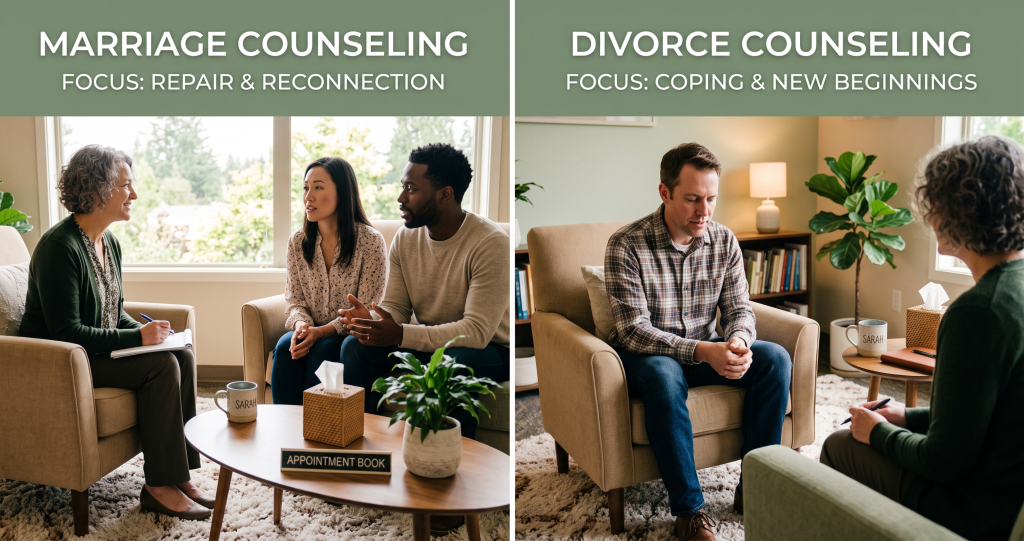
Marriage counseling also called couples therapy operates from the premise that the relationship can and should be saved. The therapist works with both partners to identify the sources of conflict, improve communication, rebuild trust, and strengthen the emotional bond between them. The shared goal is to repair the marriage and create a healthier partnership going forward.
Divorce counseling, by contrast, begins with the acknowledgment that the marriage has ended or is very likely to end. The therapist does not attempt to repair the relationship. Instead, the focus shifts entirely to helping the individuals involved navigate the separation process as constructively and compassionately as possible. This includes managing the emotional fallout, protecting children from unnecessary harm, facilitating respectful communication between former partners, and laying the groundwork for a stable post-divorce life.
It is important to understand that divorce counseling can still involve both partners. This is especially common when co-parenting is involved and the couple needs professional support to establish healthy boundaries, communication patterns, and shared parenting strategies. In these cases, the therapist is not working to reunite the couple but rather to help them transition from romantic partners to effective co-parents.
The distinction matters because seeking the wrong type of therapy can create frustration, false hope, or delayed healing. If the decision to divorce has been made or if one partner has firmly decided the relationship is over marriage counseling is unlikely to be productive. Divorce counseling meets people where they actually are and provides the support that their current situation demands.
Why People Seek Divorce Counseling
People arrive at divorce counseling for a wide range of reasons, though the underlying theme is almost always the same: they are dealing with more than they can handle alone, and they need professional guidance to move through the process without causing unnecessary damage to themselves, their children, or their future.
The most common reasons include:
Emotional overwhelm. Divorce activates a complex mixture of emotions that can feel contradictory and disorienting. Grief, anger, fear, guilt, relief, sadness, and confusion often coexist simultaneously, making it difficult to think clearly or make sound decisions. A divorce counselor helps clients process these emotions in a structured, supported way rather than allowing them to drive impulsive reactions.
Repeated volatile arguments or communication breakdowns. When every conversation with a soon-to-be former spouse escalates into conflict, it becomes impossible to make progress on the practical matters that require agreement. Divorce counseling teaches communication techniques that allow difficult conversations to happen without descending into hostility.
Inability to agree on critical decisions. Finances, property division, custody arrangements, living situations, and parental responsibilities all require agreement between two people who may no longer trust each other’s intentions. A counselor provides a neutral framework for working through these decisions collaboratively.
Concerns about the impact on children. Parents frequently seek divorce counseling because they are deeply worried about how the separation will affect their children. Counselors help parents develop strategies for talking to children about the divorce, maintaining stability across two households, and presenting a united front even when significant disagreements remain unresolved in the background.
Difficulty navigating social situations. Telling family members, friends, coworkers, and community members about a divorce creates its own set of stresses. Clients often feel uncertain about what to share, how to handle unsolicited advice, and how to manage the social identity shift that comes with no longer being part of a married couple.
Desire for an unbiased, professional perspective. Friends and family members, however well-intentioned, bring their own biases, emotions, and agendas to conversations about divorce. A counselor provides something that personal relationships cannot: an objective, professionally trained perspective that is focused entirely on the client’s well-being.
Who Can Benefit From Divorce Counseling?
Divorce counseling is not limited to a specific profile or set of circumstances. It serves a broad range of people at every stage of the separation process:
- Individuals who initiated the divorce and are dealing with guilt, second-guessing, or the emotional burden of having made a life-altering decision
- Individuals who did not want the divorce and are coping with feelings of rejection, abandonment, anger, or grief
- Couples going through a mutual separation who want to end the marriage as respectfully and cooperatively as possible
- Parents who need co-parenting strategies to protect their children’s emotional well-being and maintain stability across two households
- Children and family members who are affected by the divorce and need support processing their own feelings and adjusting to new family dynamics
- People struggling with post-divorce identity and self-esteem who need help rediscovering who they are outside of the marriage and rebuilding confidence in their ability to create a fulfilling life
If any of these descriptions resonate with your experience, divorce counseling was designed for you.
Types of Divorce Counseling: Pre-Divorce, Post-Divorce, and Discernment Counseling
Not all divorce counseling looks the same. Different approaches serve different stages and circumstances of the separation process. Understanding which type is most appropriate for your current situation helps ensure that you receive the right kind of support at the right time.
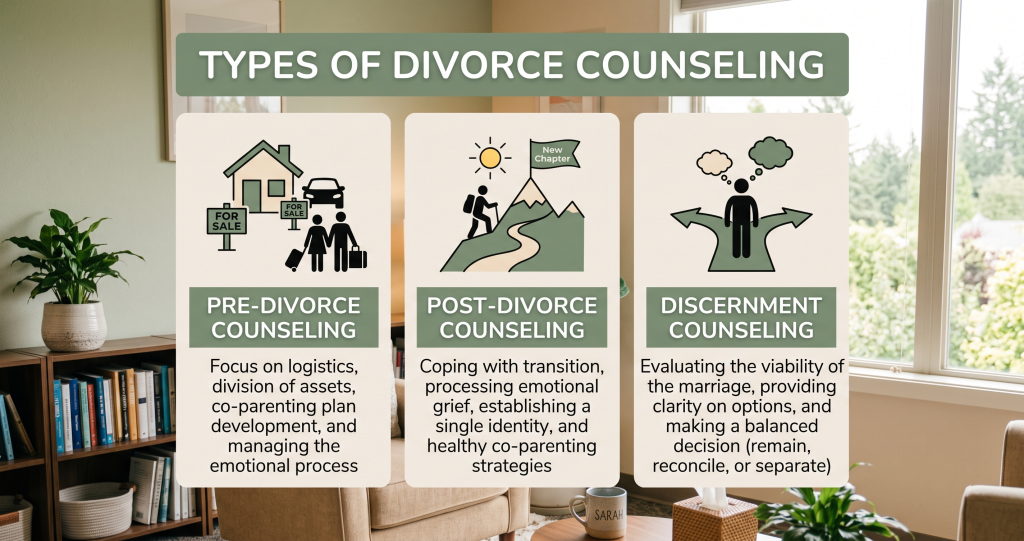
Pre-Divorce Counseling
Pre-divorce counseling is designed for individuals and couples who have decided to separate or are in the process of separating and need support navigating the early stages of that transition. The primary goal is to facilitate respectful, productive communication during what is often the most emotionally charged phase of the divorce process.
This type of counseling is particularly valuable when children are involved. A divorce counselor helps parents develop communication patterns that prioritize their children’s well-being, teaching them to separate their personal emotional reactions from the practical decisions that need to be made about custody, visitation, schooling, and daily routines.
Pre-divorce counseling also focuses heavily on conflict resolution. When two people who are hurt, angry, or fearful need to make decisions about finances, property, and living arrangements, the risk of escalation is high. A counselor teaches specific techniques for managing disagreement without hostility, helping couples resolve important matters without the emotional and financial cost of prolonged legal battles.
Perhaps most importantly, pre-divorce counseling establishes the foundation for the post-divorce relationship. The patterns of communication and cooperation that are built during this phase often determine whether the ongoing relationship especially around co-parenting will be functional and healthy or marked by continued conflict.
Post-Divorce Counseling
Post-divorce counseling supports individuals in the period after the divorce has been finalized, when the initial crisis has passed but the deeper work of healing and rebuilding has just begun. This is often the stage where the full emotional weight of the separation becomes most apparent.
During the marriage and the divorce proceedings themselves, many people operate in survival mode focused on logistics, legal requirements, and immediate needs. Once the paperwork is signed and the dust begins to settle, the grief often arrives in full force. Clients mourn not just the relationship itself, but the future they had planned, the shared dreams that will never be realized, and the familiar routines that provided a sense of stability and identity.
Post-divorce counseling focuses on several critical areas:
Self-esteem restoration. Many people emerge from a divorce questioning their worth, their judgment, and their capacity for future happiness. A skilled therapist helps clients reconnect with their strengths, rebuild confidence, and develop a renewed sense of personal identity that exists independently of the marriage.
Coping with practical changes. Single parenting, financial adjustments, managing a household alone, and navigating a changed social landscape all create significant stress. Counseling helps clients develop practical strategies for managing these new responsibilities while simultaneously processing the emotional aftermath.
Preparing for future relationships. When the time is right, post-divorce counseling helps clients identify the patterns from their marriage that they want to change, clarify what they are looking for in a future partner, and ensure that they are entering new relationships from a place of emotional health rather than loneliness or desperation.
Addressing lingering emotional patterns. Unresolved anger, trust issues, or patterns of conflict avoidance from the marriage can follow individuals into their post-divorce lives and future relationships. Therapy provides the space to identify and work through these patterns before they cause harm in new contexts.
Discernment Counseling for Divorce
Discernment counseling is a specialized, short-term approach designed for couples who are not yet certain whether they want to divorce. It is particularly effective for what therapists call “mixed-agenda” couples situations where one partner wants to work on the marriage while the other is leaning toward separation.
Unlike traditional marriage counseling, which requires both partners to commit to working on the relationship, discernment counseling does not ask for that commitment upfront. Instead, it provides a structured process typically one to five sessions during which both partners explore their feelings, motivations, and hopes with the support of a trained counselor. The goal is not to save the marriage or to end it, but to help both partners gain enough clarity and confidence to make an intentional decision about what comes next.
Discernment counseling can lead to one of three outcomes:
- The couple decides to stay together and actively work on the relationship, potentially entering marriage counseling with renewed motivation and clarity.
- The couple decides to move forward with divorce, having explored the decision thoroughly and feeling confident in their choice.
- The couple commits to a specific period of intensive marriage counseling to give the relationship one final, focused effort before making a final decision.
The defined timeframe of discernment counseling is one of its most valuable features. It prevents couples from remaining stuck in painful limbo neither fully committed to the marriage nor ready to leave which can be deeply damaging to both partners and to any children involved. By providing structure and a clear endpoint, discernment counseling ensures that a decision is made rather than endlessly deferred.
Divorce Counseling vs. Marriage Counseling vs. Divorce Mediation — Key Differences
Understanding the distinctions between divorce counseling, marriage counseling, and divorce mediation is essential for choosing the right type of support for your situation. While these services share some overlap, they serve fundamentally different purposes and are delivered by different types of professionals.
| Feature | Divorce Counseling | Marriage Counseling | Divorce Mediation |
|---|---|---|---|
| Primary Goal | Support emotional healing and healthy separation | Repair and strengthen the marriage | Negotiate legal terms of separation |
| Focus | Emotional processing, coping skills, co-parenting | Communication, trust, reconnection | Property division, custody, finances |
| Who Attends | Individuals, couples, or families | Couples together | Couples with a neutral mediator |
| When to Use | During or after the divorce decision | Before the divorce decision | During legal proceedings |
| Professional Type | Licensed therapist (LCSW, MFT, psychologist) | Licensed couples therapist | Certified mediator (often a legal professional) |
| Typical Duration | Weeks to several months | Months to years | A few focused sessions |
| Addresses Children | Yes co-parenting, family sessions | Sometimes indirectly | Only regarding custody arrangements |
| Emotional Support | Core focus | Secondary to relationship repair | Minimal primarily procedural |
| Legal Guidance | No (but supports emotional readiness for legal process) | No | Yes |
Important note: These services are not mutually exclusive. Many people benefit from using divorce counseling and divorce mediation simultaneously. Counseling provides the emotional support and communication skills needed to participate effectively in mediation, while mediation handles the legal and financial dimensions of the separation. Together, they create a comprehensive support system that addresses the full spectrum of challenges that divorce presents.
10 Key Benefits of Divorce Counseling
The benefits of divorce counseling extend far beyond having someone to talk to during a difficult time. Professional therapeutic support creates measurable, lasting improvements in emotional health, practical functioning, and relational quality not just for the individuals going through the divorce, but for their children and extended family members as well.
Emotional and Psychological Benefits
1. A safe, nonjudgmental space to process complex emotions. Divorce generates a storm of feelings that can feel overwhelming and contradictory. A counselor provides a contained environment where grief, anger, fear, guilt, and even relief can be expressed and explored without judgment, escalation, or consequence.
2. Prevention of chronic mental health complications. Without professional support, the stress of divorce can develop into persistent anxiety, clinical depression, or unhealthy coping mechanisms such as substance use, social withdrawal, or emotional numbing. Divorce counseling intervenes early, providing tools and strategies that prevent acute distress from becoming chronic mental health conditions.
3. Identity rebuilding and self-esteem restoration. Marriage creates a shared identity. When that marriage ends, many people struggle to answer the question, “Who am I now?” Divorce counseling supports the process of rediscovering personal strengths, values, and aspirations that exist independently of the former relationship.
4. Normalization of the grief process. Many people feel ashamed of the intensity of their grief after divorce, especially if they were the one who initiated the separation. A counselor normalizes these feelings, helping clients understand that grief is a natural and necessary response to significant loss and that healing is not linear.
5. Emotional support beyond what personal relationships can provide. Friends and family members care deeply, but they have their own biases, emotional reactions, and limitations. They may offer advice that feels judgmental, take sides, or simply become fatigued by the ongoing nature of divorce-related stress. A counselor provides consistent, professional, unbiased support that does not diminish over time.
Practical and Relational Benefits
6. Improved communication with the former spouse. Divorce counseling teaches specific techniques for managing difficult conversations using “I” statements, separating emotions from facts, and de-escalating conflict that make ongoing interactions more productive and less harmful.
7. Effective co-parenting strategies. When children are involved, divorce counseling helps parents develop coordinated approaches to parenting across two households, including consistent rules, shared scheduling, and communication protocols that minimize children’s exposure to parental conflict.
8. Navigation of difficult conversations about custody, finances, and logistics. A counselor helps clients prepare for and process conversations about the practical dimensions of divorce, reducing the emotional charge that often derails these discussions.
9. Reduced overall divorce costs. By helping couples reach agreements on key issues through improved communication and conflict resolution, divorce counseling can significantly reduce the need for expensive, drawn-out legal proceedings. Couples who can negotiate cooperatively spend less time and less money in court.
10. A foundation for respectful post-divorce interactions. The communication patterns and mutual understanding developed in divorce counseling create a lasting framework for respectful interaction that benefits everyone involved, particularly children who will continue to be affected by the quality of their parents’ relationship for years to come.
What Happens in Divorce Counseling Sessions?
Understanding what to expect from divorce counseling sessions can reduce anxiety about the process and help you prepare to engage fully in the therapeutic work. While every counselor’s approach is slightly different, most follow a consistent structure designed to maximize benefit while respecting your time, energy, and emotional capacity.
Initial Assessment and Goal Setting
The first one to two sessions typically focus on comprehensive assessment. Your divorce counselor will gather information about your current emotional state, the history of your marriage, the current status of divorce proceedings, your children’s needs and well-being, your financial situation, and the strength of your existing support system.
This is not an interrogation. It is a collaborative conversation designed to help the counselor understand your unique circumstances so that they can create a treatment plan tailored specifically to your most pressing concerns. You will also have the opportunity to share what you hope to achieve through counseling whether that is managing overwhelming emotions, improving communication with your ex-spouse, developing co-parenting strategies, or rebuilding your sense of self.
Based on this assessment, the counselor will work with you to identify immediate priorities and longer-term therapeutic goals. This personalized treatment plan becomes the roadmap for your work together.
Session Structure and Frequency
Regular divorce counseling sessions typically last 50 to 60 minutes and are held weekly or biweekly, depending on your needs, schedule, and the intensity of your current circumstances. Some clients benefit from more frequent sessions during particularly challenging periods such as custody hearings, moving into a new home, or navigating the first holidays after separation and then transition to less frequent meetings as stability increases.
Each session generally follows a structured format:
- Check-in: A brief review of the previous week’s challenges, successes, and emotional state
- Focused therapeutic work: Targeted work on specific goals from your treatment plan, which might include processing a difficult event, practicing communication skills, or working through grief
- Skill building and practice: Introduction or refinement of coping strategies, communication techniques, or mindfulness practices
- Reflection and homework: Assignment of exercises, journaling prompts, or real-life practices to complete between sessions
This structure provides consistency and direction while remaining flexible enough to address urgent concerns that arise between sessions.
Session Formats in Divorce Counseling
Divorce counseling is not a one-size-fits-all model. Different session formats serve different purposes, and your counselor may recommend one or a combination based on your circumstances.
Individual sessions provide a private, confidential space for processing personal emotions, developing individual coping strategies, and working through issues that are specific to your experience of the divorce. This is where much of the deep emotional work happens the grief processing, identity rebuilding, and personal growth that form the foundation of long-term healing.
Couples sessions bring both former partners together to work on specific shared challenges, most commonly communication improvement and co-parenting coordination. These sessions are not about revisiting the reasons for the divorce or assigning blame. They are focused, forward-looking, and centered on practical outcomes that benefit both parties and their children.
Family sessions include children and are designed to address the family-wide impact of the divorce. In these sessions, children have the opportunity to express their feelings, ask questions, and receive reassurance in a professionally facilitated environment. Parents learn how to respond to their children’s concerns with honesty, empathy, and age-appropriate information.
Treatment Duration
The length of divorce counseling varies significantly based on individual circumstances. Some clients achieve their primary goals within six to eight weeks of focused work, while others benefit from several months of ongoing support through the entire divorce process and beyond.
Many clients find that periodic check-in sessions remain valuable even after regular therapy ends. Significant transitions such as a former spouse remarrying, children entering a new school, changes in custody arrangements, or the client beginning a new relationship can reactivate emotional challenges that benefit from professional support.
Online divorce counseling has proven equally effective as in-person therapy for most therapeutic goals and offers particular advantages during divorce, including increased scheduling flexibility, greater privacy, and accessibility during periods when legal proceedings or parenting responsibilities make it difficult to attend in-person appointments.
Evidence-Based Techniques and Approaches in Divorce Counseling
Effective divorce counseling is not based on generic advice or well-meaning platitudes. It is grounded in evidence-based therapeutic techniques that have been researched, tested, and refined through decades of clinical practice. Understanding these approaches helps you recognize the quality of the therapy you are receiving and participate more actively in your own healing.
Cognitive Behavioral Therapy (CBT) for Divorce
Cognitive Behavioral Therapy is one of the most widely used and extensively validated approaches for addressing the mental health challenges that accompany divorce. CBT operates on the principle that our thoughts, feelings, and behaviors are interconnected and that by changing the way we think about a situation, we can change how we feel and how we act.
During divorce, negative thought patterns often develop that intensify emotional suffering and interfere with practical functioning. These patterns include catastrophizing (“My life is completely ruined”), overgeneralizing (“I will never be happy again”), personalizing (“The divorce is entirely my fault”), and black-and-white thinking (“If the marriage failed, I am a failure as a person”).
A divorce counselor trained in CBT helps clients identify these distorted thought patterns, examine the evidence for and against them, and replace them with more balanced, accurate perspectives. This does not mean minimizing the difficulty of divorce or pretending that everything is fine. It means developing the ability to hold the pain of what is happening alongside a realistic recognition that pain is not the whole picture that healing is possible, that the future holds opportunities, and that the end of a marriage does not define a person’s worth.
The behavioral component of CBT is equally important. Clients learn to make specific changes in their daily routines and habits that support emotional healing: establishing new morning and evening routines, engaging in regular physical activity, reconnecting with neglected friendships, or practicing new communication techniques with their former spouse. These behavioral shifts create positive feedback loops that reinforce the cognitive work and accelerate overall recovery.
Mindfulness and Stress Management
Mindfulness-based techniques provide essential tools for managing the anxiety, overwhelm, and emotional reactivity that frequently accompany divorce proceedings. These practices train the mind to stay grounded in the present moment rather than spiraling into regret about the past or fear about the future.
Specific mindfulness techniques used in divorce counseling include:
Deep breathing exercises that can be deployed during high-stress moments before a difficult conversation with a former spouse, during a meeting with attorneys, or when anxiety spikes unexpectedly. These techniques activate the body’s parasympathetic nervous system, reducing heart rate, lowering blood pressure, and creating a physiological state more conducive to calm, rational thinking.
Progressive muscle relaxation for managing the chronic physical tension that many people carry during divorce. Systematic tensing and releasing of muscle groups throughout the body helps clients become aware of where they hold stress and provides a practical method for releasing it.
Daily meditation practices that build emotional regulation capacity over time. Even five to ten minutes of daily meditation has been shown to reduce anxiety, improve mood, and increase the ability to respond thoughtfully rather than react impulsively a skill that proves invaluable during divorce negotiations and co-parenting interactions.
Stress management strategies that address the practical dimensions of overwhelm, including prioritization techniques, time management frameworks, and methods for breaking large, intimidating tasks into manageable steps. These skills prove particularly valuable when clients are simultaneously managing legal paperwork, parenting responsibilities, financial adjustments, and the logistics of establishing a new household.
Communication Skills Training
Effective communication is perhaps the single most important skill developed through divorce counseling, particularly when children are involved and ongoing contact with the former spouse is necessary. Divorce counseling teaches specific, actionable communication techniques that transform hostile or unproductive interactions into functional, respectful exchanges.
Key communication skills developed in divorce counseling include:
Separating emotional reactions from factual discussions. Learning to recognize when emotion is driving a conversation and developing the ability to pause, reset, and return to the facts at hand prevents countless unnecessary escalations.
Using “I” statements. Replacing accusatory language (“You never think about anyone but yourself”) with statements that express personal experience (“I feel frustrated when our agreed schedule changes without discussion”) reduces defensiveness and keeps conversations focused on problem-solving rather than blame.
Setting and maintaining appropriate boundaries. Clients learn to define what topics, communication methods, and interaction frequencies are healthy for their situation and to enforce those boundaries consistently without hostility.
Strategies for staying calm when the other person becomes argumentative. Not every conversation with a former spouse will go smoothly. Divorce counseling provides specific techniques for managing your own emotional state when the other person escalates, including knowing when to table a conversation, how to redirect toward the agenda, and when disengagement is the healthiest choice.
Age-appropriate communication with children. Parents learn how to talk to their children about the divorce in ways that provide honest information, offer reassurance, and protect children from adult conflict. These conversations require careful balance, and professional guidance helps parents navigate them with sensitivity and skill.
Grief and Loss Processing
Divorce involves mourning multiple losses simultaneously, and the therapeutic processing of this grief is a central component of divorce counseling. Clients grieve not only the relationship itself but also the shared plans for the future, the loss of financial stability, the disruption of familiar routines, the dissolution of an intact household, and the version of life they expected to live.
A divorce counselor helps clients name and acknowledge each of these losses specifically, creating space to process emotions that might otherwise feel overwhelming or confusing. Guided reflective conversations help clients explore unresolved feelings toward their former partner, toward themselves, and toward the circumstances that led to the divorce.
Critically, divorce counselors help normalize the grief process itself. Grief is not linear. It does not move through neat stages and arrive at a tidy conclusion. Emotional setbacks are common and expected, particularly during milestones like court dates, holidays, anniversaries, or changes in custody schedules. Understanding this helps clients remain compassionate with themselves rather than feeling discouraged when difficult emotions resurface after a period of apparent progress.
Forgiveness and Emotional Release Work
Forgiveness is one of the most challenging and most important aspects of divorce recovery. Whether the divorce resulted from betrayal, neglect, incompatibility, or a combination of factors, most people carry some degree of resentment, blame, or unresolved anger that can become toxic if left unaddressed.
Divorce counseling approaches forgiveness not as a single act of willpower but as a gradual, ongoing process. Clients learn that forgiveness does not mean condoning what happened, excusing harmful behavior, or pretending that everything is acceptable. It means choosing to release the emotional grip that anger and resentment have on your present life so that they do not contaminate your future.
This work is deeply personal and cannot be rushed. Some clients begin forgiveness work relatively early in the counseling process, while others are not ready to engage with it until significant emotional healing has already occurred. A skilled divorce counselor meets clients where they are and supports the process at a pace that feels authentic and sustainable.
Equally important is the capacity to ask for forgiveness acknowledging one’s own contributions to the relationship’s failure, showing vulnerability, and offering genuine accountability. This dual process of giving and receiving forgiveness builds a foundation of emotional freedom that supports healthier future relationships and more peaceful co-parenting interactions.
How to Start Divorce Counseling: A Step-by-Step Guide
Beginning divorce counseling can feel daunting, especially when you are already overwhelmed by the demands of the separation process. This step-by-step guide breaks the process into manageable stages, helping you move from recognizing the need for support to actively engaging in therapeutic work that transforms your experience.
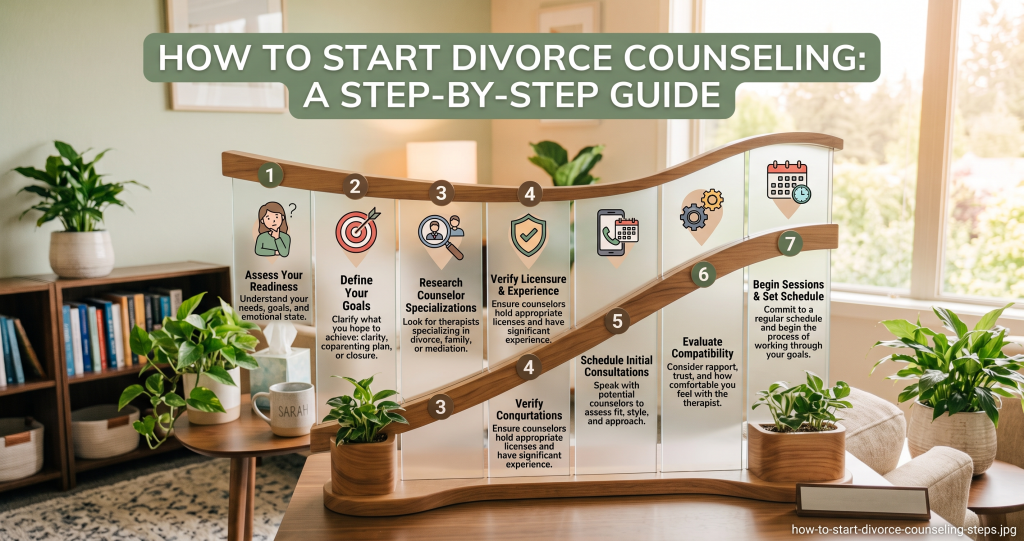
Step 1 — Acknowledge the Need for Professional Support
The first and often most difficult step is acknowledging that you need help. This is not a sign of weakness it is a sign of self-awareness and emotional intelligence. Look for these indicators that professional support would benefit you:
Emotional indicators: Persistent sadness or depression that does not lift, anxiety that interferes with daily functioning, uncontrollable anger that spills into interactions with children, friends, or colleagues, or feelings of numbness and emotional disconnection that prevent you from engaging with your life.
Behavioral indicators: Social withdrawal from friends and family who care about you, significant changes in sleep patterns (sleeping far too much or too little), dramatic weight fluctuations, increased use of alcohol or other substances, or inability to concentrate on work or daily responsibilities.
Impact on children: When your children begin showing signs of distress behavioral changes, declining academic performance, increased clinginess or withdrawal, or expressions of fear and confusion family therapy can provide crucial support for their adjustment while helping you learn to minimize the negative effects of the separation on their emotional well-being.
If you or someone you know is experiencing thoughts of suicide or self-harm, immediate crisis intervention is necessary. The 988 Suicide & Crisis Lifeline provides 24/7 support by phone or chat.
Step 2 — Determine the Right Type of Divorce Counseling for Your Situation
Once you have acknowledged the need for support, identify which type of divorce counseling best matches your current circumstances:
- Choose pre-divorce counseling if separation is underway or imminent and you need help communicating with your spouse, making decisions about practical matters, and establishing co-parenting foundations.
- Choose post-divorce counseling if the divorce has been finalized and your focus is on emotional healing, identity rebuilding, and adjusting to the realities of your new life.
- Choose discernment counseling if you are not yet certain whether divorce is the right decision and need a structured process for gaining clarity.
If you are unsure which type fits your situation, a brief consultation with a licensed therapist can help you clarify your goals and determine the most appropriate approach.
Step 3 — Find a Qualified Divorce Counselor
The quality of your counselor significantly impacts the effectiveness of your therapeutic work. Look for licensed mental health professionals with specific training and experience in divorce-related issues:
- Licensed Clinical Social Workers (LCSW)
- Marriage and Family Therapists (MFT)
- Licensed Professional Counselors (LPC)
- Psychologists with postgraduate training in divorce therapy
When evaluating potential counselors, ask about their experience with divorce counseling specifically, their approach to co-parenting issues, their familiarity with high-conflict situations, and the evidence-based techniques they use. Verify that their insurance policies, fees, scheduling availability, and session formats (in-person, online, or both) align with your needs.
Step 4 — Prepare for Your First Session
Preparation helps you make the most of your initial appointment. Before your first session:
- Write down your primary concerns, questions, and goals for counseling. What are you most struggling with? What do you hope to achieve?
- Gather relevant context that will help your counselor understand your situation: the general history of your marriage, the current status of divorce proceedings, your children’s ages and needs, and any immediate crises or decisions that require attention.
- Approach the process with openness and patience. Healing takes time, and the most meaningful therapeutic work often happens gradually. Being honest with your counselor even when it feels uncomfortable creates the foundation for genuine progress.
Step 5 — Engage Actively in the Therapeutic Process
Therapy is not a passive experience. The clients who benefit most from divorce counseling are those who engage actively in the process:
- Attend sessions consistently. Regularity builds momentum and allows the therapeutic relationship to deepen over time.
- Complete any reflection exercises, journaling prompts, or homework assigned between sessions. These activities extend the benefits of therapy beyond the counseling room and into your daily life.
- Practice communication techniques, coping strategies, and mindfulness exercises in real-life situations. Skills develop through application, and your counselor can help you refine your approach based on what works and what does not.
Step 6 — Apply Coping Skills and Strategies to Daily Life
The ultimate goal of divorce counseling is not just to feel better during sessions but to develop practical skills that improve your daily experience:
- Use stress management techniques deep breathing, grounding exercises, progressive muscle relaxation during difficult conversations with your former spouse, meetings with attorneys, or moments when anxiety spikes unexpectedly.
- Implement co-parenting strategies consistently to protect your children’s well-being and create stability across both households.
- Prioritize self-care in concrete, specific ways: regular physical exercise, consistent sleep routines, nutritious eating, social connection with people who support you, and dedicated time for activities that bring you moments of peace or joy.
Step 7 — Transition From Counseling When Ready
There is no predetermined timeline for completing divorce counseling. You and your therapist will collaboratively recognize when the time is right to reduce or end regular sessions. Signs of readiness include:
- Improved emotional regulation you are able to manage difficult emotions without being overwhelmed by them
- Increased self-confidence and a clearer sense of personal identity
- Healthier communication patterns with your former spouse
- Effective co-parenting relationships that prioritize your children’s well-being
- A forward-looking perspective that includes realistic optimism about the future
Discuss a transition plan with your counselor that may include gradually spacing out sessions rather than stopping abruptly. Many clients find that periodic check-in sessions remain valuable during significant transitions holidays, changes in custody arrangements, children entering new developmental stages, or the beginning of new romantic relationships.
How Divorce Counseling Supports Children and Co-Parenting
When children are part of the equation, the stakes of divorce counseling extend beyond the couple themselves. Children are deeply affected by the divorce process, and the way parents handle the separation has lasting implications for children’s emotional development, academic performance, social relationships, and overall sense of security.
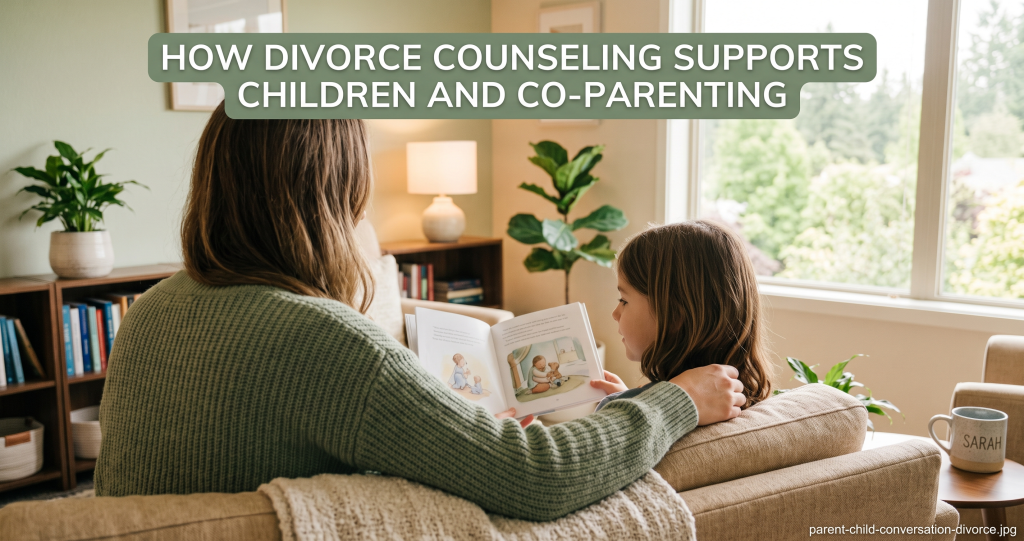
Divorce counseling provides parents with the knowledge, skills, and support needed to protect their children during this transition and to lay the groundwork for a co-parenting relationship that serves their children’s best interests for years to come.
Talking to Children About Divorce
One of the most difficult conversations any parent will ever have is telling their children that the family is changing. Divorce counseling helps parents approach this conversation with intentionality, sensitivity, and a clear plan.
Key principles for talking to children about divorce include:
Explain the divorce clearly and simply without assigning blame. Children need to understand what is happening, but they do not need to know the details of what went wrong in the marriage. Frame the conversation around the future what will change and what will stay the same rather than the past.
Reassure children unequivocally that they are not at fault. This cannot be stated too many times or too emphatically. Children, especially younger ones, are prone to believing that they caused the divorce through their behavior. Parents must proactively and repeatedly counteract this tendency.
Provide age-appropriate information while protecting children from adult conflict. A five-year-old and a fifteen-year-old need different levels of information and different types of reassurance. A counselor helps parents calibrate their communication to each child’s developmental stage and emotional capacity.
Present a united front, even when significant disagreements remain unresolved. Children’s sense of security depends on their perception that both parents are working together to take care of them. Even when parents are struggling to agree behind the scenes, the message to children should be consistent: both parents love them, both parents will always be there for them, and the family will be okay.
Co-Parenting Strategies Developed in Divorce Counseling
Effective co-parenting does not happen automatically. It requires intentional effort, clear communication, and in many cases professional guidance to establish patterns that work for everyone involved.
Divorce counseling helps parents develop and practice several critical co-parenting skills:
Sharing information about school, health, and daily logistics with minimal emotional escalation. Counselors help parents establish communication protocols whether through email, a shared app, or structured conversations that keep exchanges focused on children’s needs and free from personal conflict.
Developing clear communication boundaries between co-parents. Not every text message requires an immediate response. Not every disagreement requires a lengthy discussion. Setting appropriate boundaries around communication frequency, methods, and topics protects both parents’ emotional well-being and models healthy boundaries for children.
Approaching disagreements with a problem-solving mindset. When co-parents disagree and they will the ability to focus on finding solutions rather than assigning blame prevents escalation and models constructive conflict resolution for children.
Recognizing when disengagement is healthier than continued debate. Not every battle needs to be fought. Divorce counseling helps parents distinguish between issues that genuinely require resolution and issues that are better released. Learning to let go of minor disagreements preserves emotional energy for the decisions that truly matter.
Creating predictable, stable environments across both households. Consistency in rules, routines, and expectations across two homes helps children feel secure and reduces the anxiety that comes with constant adjustment. Divorce counseling helps parents coordinate on bedtimes, screen time, homework expectations, and discipline approaches to create as much stability as possible.
When Family Therapy Is Needed
In some cases, individual or couples-focused divorce counseling is not sufficient to address the needs of the entire family. Family therapy becomes important when children are showing signs of significant distress:
- Behavioral changes such as increased aggression, defiance, or withdrawal
- Declining academic performance or loss of interest in activities they previously enjoyed
- Physical symptoms such as stomachaches, headaches, or sleep disturbances that do not have a medical explanation
- Expressions of fear, anger, or sadness that seem disproportionate or persistent
Family therapy sessions provide children with a safe, structured environment to articulate their fears and concerns with the guidance of a professional who can help translate their feelings into language that parents can understand and respond to. These sessions also help parents see the divorce through their children’s eyes, building empathy and informing more child-centered decision-making.
Essential Coping Skills for Navigating the Divorce Process
The emotional intensity of divorce can make it difficult to function effectively in daily life. The following coping strategies commonly taught and reinforced through divorce counseling provide practical tools for managing the most challenging aspects of the separation process.
Managing Your Own Behavior
During divorce, the temptation to react to a former spouse’s hurtful or frustrating behavior is enormous. Emotions run high, and it can feel deeply unfair to remain composed when the other person is being difficult, unreasonable, or deliberately provocative.
The most important principle to internalize is this: you cannot control how the other person feels or acts, but you can always choose how you respond. This is not about being passive or accepting unacceptable behavior. It is about refusing to let someone else’s actions determine the quality of your own conduct.
Practical strategies include:
- Pause before responding. When you feel the urge to fire back an angry text or raise your voice during a conversation, take a deliberate pause. Even thirty seconds of conscious breathing can create enough space to choose a response that you will not regret.
- Take time-outs during heated discussions. There is no rule that says every conversation must reach a conclusion in one sitting. Saying, “I need a few minutes to think about this. Can we come back to it later?” is not avoidance it is emotional intelligence.
- Separate the person from the behavior. Your former spouse may be acting in ways that are hurtful, but those actions are likely driven by their own pain, fear, or desperation. Recognizing this does not excuse the behavior, but it can help you respond with composure rather than escalation.
Coping With Anger During Divorce
Anger is one of the most common and most destructive emotions that surfaces during divorce. Left unmanaged, it can poison co-parenting relationships, traumatize children, and create legal complications that extend the divorce process and increase its cost.
Divorce counseling provides specific techniques for recognizing and managing anger before it takes control:
Recognize the early warning signs. Anger rarely arrives without physical precursors. Rapid breathing, increased heart rate, muscle tension, a clenched jaw, a hot sensation in the chest or face learning to recognize these signals gives you a window to intervene before the emotion overwhelms your ability to think clearly.
Use grounding techniques immediately. When you notice anger building, deploy a grounding technique: take three slow, deep breaths. Step outside and feel the air on your skin. Press your feet firmly into the floor and notice the sensation. Tell yourself, “I am in control. This feeling will pass. I can handle this.”
Table conversations that are escalating. If a discussion with your former spouse is moving toward a fight, it is always better to pause the conversation than to continue into territory that will cause damage. “I want to resolve this, but I think we’ll make better decisions if we come back to it tomorrow” is a powerful and mature statement.
Shift your language patterns. Replace adversarial language with collaborative language. Instead of “Yes, but…” try “I understand your perspective, and…” Instead of “You always…” try “I’ve noticed that…” These small shifts can dramatically change the tone and trajectory of a conversation.
Journal about your anger. Between difficult interactions, write about what triggered your anger, what you were feeling in your body, what thoughts were running through your mind, and how you responded. Then write about a time when you successfully managed a similar situation without losing control. This practice builds self-awareness and reinforces your capacity for emotional regulation.
Prioritizing Self-Care During Divorce
During divorce, self-care is not selfish it is essential. You cannot navigate the demands of the separation process, parent your children effectively, or build a healthy future if you are running on empty.
Self-care during divorce looks different for everyone, but the underlying principle is the same: you must intentionally dedicate time and energy to your own physical, emotional, and mental well-being, even when it feels like there is no time or energy to spare.
Establish daily routines that support fundamental well-being: consistent sleep and wake times, regular nutritious meals, and some form of physical activity even a twenty-minute walk. These routines provide structure and predictability during a period when everything else feels uncertain.
Schedule time for activities that restore you. This might be reading a book that has nothing to do with divorce, listening to music that lifts your mood, spending time in nature, engaging in a creative hobby, or simply sitting in a quiet room with a cup of coffee and no demands on your attention.
Lean on your support system. Identify the friends and family members who make you feel genuinely supported not judged, not pitied, not advised, but supported and make a conscious effort to maintain those connections. If you are struggling to identify such people, this is a clear signal that professional support through divorce counseling is especially important.
Limit exposure to unnecessary stressors. If checking your former spouse’s social media is causing you pain, remove the apps from your phone for a while. If certain topics of conversation with well-meaning friends leave you feeling worse, set a gentle boundary. Protecting your emotional energy during this period is not avoidance it is strategic self-preservation.
Preparing for Unexpected Reactions
You may feel that you know your former spouse well enough to predict how they will react to any given situation. During divorce, however, you are both in uncharted territory. Hurt, fear, and feelings of betrayal can cause people to behave in ways that are entirely out of character sometimes shockingly so.
Preparing for difficult conversations by clarifying your own goals in advance helps you stay focused regardless of how the other person responds. Before any important discussion, take time to answer three questions: What outcome am I genuinely hoping for? What am I willing to compromise on? What is my bottom line?
Writing down key points or even composing a letter before the conversation can help ensure that your most important messages are communicated clearly, even if the emotional temperature of the conversation rises unexpectedly.
Focusing on a Brighter Future
The divorce process can feel like an endless tunnel with no light at the end. It is vital to remind yourself regularly and deliberately that one or both parties entered this process hoping to leave behind a situation that was no longer working in order to build something better.
Take time to visualize your life three months from now. Six months from now. A year from now. What does a good day look like? Where are you living? What are you doing with your time? How do your relationships with your children feel? What new experiences are you having?
This is not naive optimism. It is a scientifically supported technique mental contrasting and future-oriented visualization that provides emotional fuel during difficult moments and keeps your decision-making oriented toward the life you want to build rather than the one you are leaving behind.
Carry this vision with you into difficult conversations and challenging decisions. Remind yourself that the discomfort you are experiencing now is temporary, and that every agreement reached, every boundary set, and every moment of restraint exercised is an investment in a more settled, more peaceful future.
Helpful Divorce Counseling Worksheets and Exercises
Divorce counseling frequently incorporates structured exercises and worksheets that help clients organize their thoughts, process their emotions, and develop practical strategies for managing the challenges of separation. The following tools are commonly used by therapists and can also serve as valuable resources for individuals working through the divorce process independently.
Divorce Problem-Solving Worksheet
The divorce process presents an ongoing series of problems that require resolution from decisions about property and finances to emotionally charged conversations about custody and living arrangements. This worksheet guides clients through a structured analysis of each problem they encounter, helping them identify the situation, examine their thoughts and feelings, evaluate their behavioral response, and assess the outcome.
The key question the worksheet poses after each situation is: “Is there anything you can learn from this, or anything you could do differently next time something similar happens?” This reflective element transforms each challenge into a learning opportunity and builds cumulative problem-solving competence over time.
Grieving After a Divorce Worksheet
Divorce is a form of loss that generates emotions remarkably similar to grief sadness, anger, disbelief, longing, and even relief. This worksheet helps clients explicitly name what they are losing (a friendship, intimacy, financial security, a shared home, a vision of the future) and identify the specific emotions associated with each loss.
The forward-looking component of this worksheet is particularly important: it asks clients to reflect on how they could change their life, what steps they could take to start again, and what learnings they could carry forward from the experience. This combination of acknowledgment and forward orientation supports a healthy grief process that does not become stuck in the past.
Facing the Fear of Divorce Worksheet
Change of any magnitude can be frightening. A change as significant as divorce can generate intense anxiety about an unknown future. This worksheet helps clients distinguish between what they are afraid will happen and what is actually likely to happen a critical distinction that reduces anxiety and builds realistic confidence.
Clients are guided through a series of questions: What are you worried will happen? What evidence suggests this is likely? What evidence suggests it is not likely? If it does not come true, what is more likely to happen instead? And if it does come true, how will you handle it and why will you eventually be okay?
This exercise draws on principles from cognitive behavioral therapy, teaching clients to evaluate their fears rationally rather than accepting them as predetermined truths.
Self-Care During a Divorce Worksheet
This worksheet helps clients who are so focused on taking care of everyone and everything else that they have neglected their own well-being. It prompts reflection on what the client is currently doing to look after themselves, asks them to identify three things they could do exclusively for their own benefit, and encourages them to schedule specific daily time for self-care activities.
The worksheet also encourages clients to commit to daily physical exercise, identify activities that bring moments of peace or joy, and plan social connection with supportive friends all of which are evidence-based strategies for maintaining mental health during high-stress periods.
Moving On to New Relationships Worksheet
While starting a new relationship may be the last thing on a client’s mind during or immediately after divorce, the time will eventually come when they are ready to open themselves to new connection. This worksheet helps clients assess their emotional readiness and develop clarity about what they are looking for.
Key reflective questions include: What did you not have in your last relationship that you would like in your next one? If you have children, what qualities are important in a new partner? Are you considering a new relationship because you genuinely feel ready, or because of external pressure? Are you starting a relationship to upset your former spouse or to “win” the post-divorce competition? The honest answers to these questions help prevent premature or unhealthy relationship choices.
The Win-Win Waltz Communication Exercise
This exercise helps couples move from opposing positions to a shared understanding during the negotiation of divorce terms. It guides both parties through identifying their initial positions, exploring the underlying concerns behind those positions, and brainstorming solution options that address both parties’ core needs.
The exercise produces three categories of potential solutions: the first partner’s initial solution modified to incorporate the second partner’s concerns, the second partner’s initial solution modified to incorporate the first partner’s concerns, and entirely new ideas that neither partner had considered independently. This structured approach transforms adversarial negotiation into collaborative problem-solving.
How to Find the Right Divorce Counselor for Your Needs
The therapeutic relationship between you and your divorce counselor is one of the most important factors in the effectiveness of your treatment. Finding the right counselor someone whose expertise, approach, and interpersonal style match your needs is worth investing time and effort.

Qualifications to Look For
Seek out licensed mental health professionals with specific training and demonstrated experience in divorce-related therapy. The most relevant credentials include:
- Licensed Clinical Social Workers (LCSW) with experience in family dynamics and life transitions
- Marriage and Family Therapists (MFT) who specialize in relationship dissolution and co-parenting
- Licensed Professional Counselors (LPC) with training in grief, trauma, and adjustment disorders
- Psychologists with postgraduate training in divorce therapy, family systems, or child psychology
- Professionals with additional certifications in areas such as child custody evaluation, collaborative divorce, or high-conflict family situations
Questions to Ask a Potential Divorce Counselor
During initial consultations, ask specific questions that help you evaluate whether the counselor’s expertise and approach match your needs:
- What is your specific experience with divorce counseling?
- How do you approach co-parenting issues and high-conflict situations?
- What evidence-based techniques do you use most frequently (CBT, mindfulness, DBT, grief therapy)?
- Do you offer individual sessions, couples sessions, and family sessions?
- Do you provide online therapy options?
- What is your philosophy about the role of therapy during the divorce process?
The answers to these questions reveal not only the counselor’s qualifications but also their therapeutic philosophy and whether it aligns with your own values and expectations.
Red Flags to Avoid
Not every therapist is the right fit, and some characteristics should prompt you to continue your search:
- Counselors who promise specific outcomes. No ethical therapist can guarantee results. A counselor who promises that you will “get through this in six sessions” or “feel completely better by a certain date” is either overpromising or does not understand the complexity of divorce recovery.
- Counselors who encourage prolonged litigation. A good divorce counselor helps reduce conflict, not escalate it. If a therapist seems to be fueling adversarial attitudes or encouraging legal battles, they are not serving your best interests.
- Bias against either gender. A divorce counselor should be neutral and fair, supporting both partners’ legitimate concerns and interests. If you sense that a counselor automatically favors one gender’s perspective, look elsewhere.
- Lack of understanding of current divorce processes and family dynamics. Divorce counseling requires familiarity with the practical realities of separation custody arrangements, financial implications, and the impact on children. A counselor who seems unfamiliar with these issues may not be able to provide the comprehensive support you need.
Practical Considerations
Beyond qualifications and therapeutic approach, several practical factors affect your ability to access and sustain divorce counseling:
- Insurance coverage and payment policies. Verify that the counselor accepts your insurance or offers sliding-scale fees that fit your budget during a financially challenging time.
- Scheduling availability. Divorce often involves court dates, attorney meetings, and childcare logistics that make scheduling complex. Look for a counselor with flexibility in appointment times.
- In-person vs. online session options. Both formats are effective. Online therapy may be especially convenient during divorce when schedules are unpredictable and privacy at home may be easier than arranging transportation to an office.
- Location convenience. If you prefer in-person sessions, proximity to your home or workplace reduces the logistical burden of regular appointments.
The therapeutic relationship should feel supportive and collaborative from the very first session. Trust your instincts. If a counselor demonstrates genuine empathy, maintains appropriate professional boundaries, and possesses the clinical expertise to guide you through this challenging process, you have likely found the right match. If something feels off even if you cannot articulate exactly what it is entirely appropriate to try another counselor. Finding the right fit is more important than settling for the first option.
10 Reflective Questions to Consider Before or During Divorce Counseling
Whether you are contemplating divorce, in the middle of the process, or working through its aftermath, these reflective questions can deepen your self-awareness and inform your therapeutic work. They are not designed to change your mind or challenge your decision. They are tools for understanding your experience more fully and ensuring that your choices are grounded in clarity rather than impulse.
- Have I done everything I can to address the issues in this marriage? This is not about guilt it is about ensuring that you can move forward without the weight of unasked questions.
- Have I clearly communicated my unhappiness and requested specific changes? Sometimes the things we assume our partner knows have never actually been said directly.
- Have I considered what life will realistically look like after divorce? Not the fantasy version or the worst-case scenario, but a realistic picture of the practical and emotional realities.
- Am I financially prepared for the changes ahead? Understanding the financial implications of divorce reduces anxiety and supports better decision-making.
- How will the divorce affect my children and how will staying in an unhappy marriage affect them? Both choices carry consequences for children. Being honest about both sides of this equation helps you make a more informed decision.
- Are my expectations for marriage reasonable and informed? Sometimes the gap between expectation and reality reflects unrealistic standards rather than a fundamentally broken relationship. Sometimes it does not. Clarity matters.
- Is the marriage truly all it can be, or am I simply exhausted from trying? There is an important distinction between a relationship that has been fully explored and found wanting and one that has simply depleted the energy of both partners through sustained conflict.
- Have I contributed to both the problems and the attempted solutions? This question is not about self-blame. It is about honest self-assessment that prevents you from carrying unexamined patterns into future relationships.
- What have I learned about myself through this relationship? Every relationship teaches us something about who we are, what we need, and how we show up in intimate partnerships. Those lessons are valuable regardless of the outcome.
- Am I seeking divorce for the right reasons not out of impulse, pressure, or retaliation? Divorce is a permanent decision. Ensuring that it is driven by genuine, considered conviction rather than temporary emotional states protects you from future regret.
Take time with these questions. Discuss them with your counselor. Write about them in a journal. There are no right or wrong answers only honest ones.
Frequently Asked Questions About Divorce Counseling
What is divorce counseling and how does it work?
Divorce counseling is a specialized form of therapy designed to help individuals, couples, and families navigate the emotional and practical challenges of ending a marriage. Unlike marriage counseling, which focuses on repairing the relationship, divorce counseling acknowledges that the marriage has ended and concentrates on supporting a healthy, constructive transition. Sessions typically begin with a comprehensive assessment, followed by the creation of a personalized treatment plan, and then regular sessions focused on emotional processing, skill-building, and practical planning. Therapeutic techniques may include cognitive behavioral therapy, mindfulness training, communication skills development, and grief processing.
How long does divorce counseling take to show results?
Most clients begin experiencing some relief and improved coping skills within the first three to four sessions, particularly when learning immediate stress management techniques, communication strategies, and grounding exercises. More significant emotional healing and personal growth typically unfold over three to six months of consistent therapeutic work. The timeline varies considerably based on individual circumstances, the complexity of the divorce situation, the presence of children, and factors such as previous mental health history. Some clients benefit from ongoing periodic sessions even after the main course of treatment concludes.
Can divorce counseling help if my ex-spouse refuses to participate?
Yes. Individual divorce counseling is highly effective even when only one partner participates. You can develop healthy communication skills, build effective coping mechanisms, process your emotions about the separation, and create practical co-parenting strategies regardless of your former partner’s willingness to attend therapy. In fact, many clients find that their own improvements in communication and emotional regulation positively influence the overall family dynamic, even without the other partner’s direct involvement in the therapeutic process.
What is the difference between divorce counseling and divorce mediation?
Divorce counseling and divorce mediation serve related but distinct purposes. Divorce counseling focuses primarily on emotional support, mental health, and the development of coping and communication skills for navigating the separation process. It is provided by a licensed mental health professional. Divorce mediation, by contrast, is a legal and procedural service that helps couples negotiate the specific terms of their separation agreement property division, custody arrangements, financial settlements through the guidance of a neutral mediator who is often a legal professional. Many people benefit significantly from engaging in both services simultaneously, as counseling provides the emotional stability and communication skills that make mediation more productive and less adversarial.
Is online divorce counseling as effective as in-person therapy?
Research consistently supports the effectiveness of online divorce counseling for most therapeutic goals, including emotional support, skill-building, grief processing, and practical planning. Online therapy offers particular advantages during divorce: increased scheduling flexibility that accommodates the demands of legal proceedings and parenting responsibilities, enhanced privacy when meeting from home, accessibility for clients in rural areas or with limited transportation options, and the comfort of participating in sessions from a familiar environment during a vulnerable time. However, some high-conflict situations or cases involving safety concerns may benefit from in-person sessions. Your counselor can help you determine the most appropriate format for your specific circumstances.
How do I know if I need marriage counseling or divorce counseling?
Marriage counseling is typically most appropriate when both partners are willing to work on the relationship. They do not need to be equally committed or enthusiastic about therapy, but both must be open to trying to improve communication, trust, or connection. Divorce counseling is more appropriate when the relationship has ended or is very likely to end, when one partner has firmly decided to leave, or when the couple has already attempted marriage counseling without achieving meaningful improvement. If you are uncertain which type of counseling fits your situation, a consultation with a licensed therapist can help you clarify your goals and determine the approach that best supports you during this transition.
How does divorce counseling help children?
Divorce counseling supports children both directly and indirectly. Directly, family therapy sessions provide children with a safe, professionally facilitated space to express their feelings, ask questions, and receive reassurance. Indirectly and often more powerfully divorce counseling helps children by improving their parents’ capacity to co-parent effectively, communicate without hostility, and provide consistent emotional support. When parents learn to manage their own emotional responses, communicate respectfully with their former spouse, and present a stable, united front to their children, the negative impact of divorce on children is significantly reduced.
What therapeutic techniques are used in divorce counseling?
Divorce counselors draw from a range of evidence-based therapeutic approaches, selecting techniques based on each client’s specific needs and circumstances. The most commonly used approaches include Cognitive Behavioral Therapy (CBT) for identifying and reframing negative thought patterns, mindfulness and stress management techniques for emotional regulation, communication skills training for improving interactions with former spouses and children, grief and loss processing for working through the multiple layers of loss that divorce involves, and forgiveness work for releasing resentment and building emotional freedom. Many counselors integrate multiple approaches into a comprehensive treatment plan tailored to the client’s goals.
Moving Forward With Divorce Counseling — Your Path to Healing
Divorce is one of the most painful experiences a person can go through. It disrupts every dimension of life emotional, financial, social, logistical, and relational and it does so during a period when your capacity to cope with disruption is already strained to its limits.

But divorce is not the end of your story. It is the end of one chapter and the beginning of another one that you have the power to shape intentionally, thoughtfully, and with greater self-awareness than you may have had before.
Divorce counseling is the most effective tool available for navigating this transition with your emotional health, your relationships with your children, and your hope for the future intact. It provides what the process demands but rarely offers on its own: professional guidance, evidence-based coping strategies, a safe space for honest emotional processing, and a structured pathway from the pain of what is ending toward the possibility of what comes next.
Seeking divorce counseling is not a sign of weakness, failure, or inability to handle life’s challenges independently. It is a sign of courage the courage to acknowledge that you are going through something extraordinarily difficult and that you deserve support while you do it. It is a sign of wisdom the wisdom to recognize that professional help can prevent short-term pain from becoming long-term damage. And it is a sign of love love for your children, who deserve parents who are doing their best to protect them during this transition, and love for yourself, because you deserve a future that is not defined by the pain of the past.
If you are considering divorce counseling, take the first step today. Identify your needs. Research qualified counselors in your area or explore online therapy options. Schedule a consultation. Ask questions. Begin the conversation.
The road ahead may not be easy, but you do not have to walk it alone and with the right support, the life you are building on the other side can be everything you hope it will be.
“This article is intended for informational purposes only and is not a substitute for professional mental health advice, diagnosis, or treatment. If you are experiencing significant emotional distress or thoughts of self-harm, please contact a licensed mental health professional or call the 988 Suicide & Crisis Lifeline.”