

Few conversations in life carry the emotional weight of telling your spouse you want a divorce. Your hands might tremble. Your voice might shake. You may have rehearsed this moment a hundred times in your mind — and still feel completely unprepared when it arrives.
If you are reading this, you have likely been sitting with this decision for a long time. You have weighed it, questioned it, grieved it, and arrived at a place of quiet certainty. The decision itself may feel clear. But knowing how to actually say the words out loud — with compassion, strength, and clarity — is an entirely different challenge.
This guide exists to help you with exactly that.
Whether you are afraid of your spouse’s reaction, unsure how to find the right words, or simply trying to understand how to initiate this process with as little damage as possible, you will find everything you need here. This is not a surface-level list of vague tips. This is a complete, deeply practical, emotionally honest guide to one of the most important conversations of your life.
Because how you tell your spouse you want a divorce does not just affect this one conversation. It sets the tone for your legal process, your co-parenting relationship, your financial negotiations, and the emotional health of every person in your family — including yourself.
Let us begin.
Quick Answer: How Do You Tell Your Spouse You Want a Divorce?
To tell your spouse you want a divorce, choose a calm, private moment when children are not present, lead the conversation with empathy and “I” statements rather than blame, and state your decision clearly and directly without leaving room for ambiguity. This is a declaration of your decision, not a negotiation or a request for permission. Stay firm and compassionate in the face of emotional pushback, and avoid discussing legal or financial details in this first conversation.
Key principles to remember:
- Choose the right time and a private, distraction-free setting
- Lead with empathy, not blame or accusation
- Use “I” statements to keep the focus on your feelings and experience
- Stay calm, firm, and compassionate throughout
- Avoid discussing legal details, finances, or custody in this first conversation
- Prepare for an emotional reaction and know how you will respond
- Give your spouse time and space to process after the conversation
Why Telling Your Spouse You Want a Divorce Is One of the Hardest Conversations You Will Ever Have
Before diving into the practical steps, it is worth honoring the emotional reality of what you are facing. Understanding why this conversation feels so impossible is the first step toward preparing yourself to have it well.
The Emotional Weight Behind Initiating a Divorce
Most people who initiate a divorce have been building toward this decision for months, sometimes years. They have tried therapy, attempted conversations, pulled back from the edge, and returned to it again. By the time they are ready to say the words out loud, they have already done an enormous amount of internal processing.
And yet, despite all of that internal work, the moment of actually telling your spouse can feel paralyzing.
Why? Because the weight of this moment is not just about the words. It is about everything those words carry. It is the end of the life you built together. It is the disruption of your children’s world. It is the grief of a future you once imagined but will not have. It is the fear of your spouse’s pain, your own guilt, and the uncertainty of what comes next.
Carrying this decision alone, without being able to speak it openly, creates a particular kind of psychological exhaustion. People describe feeling like they are living a double life — knowing something enormous that their partner does not yet know. That burden is real, and it takes a genuine toll.
There is also the powerful collision of guilt and conviction. You may feel completely certain that this marriage is no longer sustainable and simultaneously devastated that you are the one ending it. Both of those feelings can be true at the same time. That is not a contradiction. That is the human complexity of love and loss living in the same moment.
One more thing worth addressing: most spouses will feel blindsided, even when the marriage has been clearly struggling. Research consistently shows that people tend to underestimate how unhappy their partners are. Even years of distance, conflict, or emotional disconnection do not always translate into an expectation of divorce. Your spouse may have convinced themselves that things would eventually improve. Do not expect them to greet your news with understanding or readiness. In most cases, they will not.

How This One Conversation Sets the Tone for Your Entire Divorce
Here is something that does not get said enough: the conversation in which you tell your spouse you want a divorce is arguably the most strategically important conversation in the entire divorce process.
The way you deliver this news will directly influence whether your divorce becomes collaborative or adversarial. It will shape how your spouse responds in the days and weeks that follow. It will affect how both of you show up for your children, how negotiations unfold, and how much emotional damage is carried forward into the next chapter of your lives.
Getting this conversation wrong does not just create a bad afternoon. It can contribute to prolonged legal battles that drain your finances and energy. It can fracture your co-parenting relationship in ways that take years to repair. It can cause genuine emotional trauma for your children if the conflict that follows becomes constant and visible. It can generate resentment that poisons every negotiation for months to come.
Getting it right, on the other hand, creates the foundation for a collaborative process. It signals to your spouse that you intend to handle this with dignity. It opens the door to mediation, cooperative co-parenting, and a divorce that does not destroy either of you in the process.
This is not a conversation to approach casually. It deserves your full preparation and your most intentional self.
This Is a Declaration, Not a Discussion
Perhaps the most important mindset shift you can make before having this conversation is this: you are not asking for your spouse’s permission to end the marriage. You are informing them of a decision you have already made.
This distinction matters enormously in practice.
When people go into this conversation hoping for agreement, understanding, or validation, they inevitably get pulled into negotiating their own decision. Their spouse pushes back, and they soften. Their spouse cries, and they backtrack. Their spouse makes promises, and suddenly the conversation has veered completely off course.
You can be deeply empathetic and still be completely unmovable. In fact, that combination — genuine compassion paired with unshakeable resolve — is exactly what this conversation requires.
Empathy means acknowledging your spouse’s pain. It means saying, “I know this is devastating, and I am sorry.” It does not mean reopening the question of whether the divorce is happening. The decision has been made. This conversation is about communicating that decision with as much care and dignity as possible.
What to Do Before You Tell Your Spouse You Want a Divorce
The conversation itself may last an hour. The preparation should take significantly longer. These are the four critical steps to take before you sit down with your spouse.
Step 1 — Be Absolutely Certain About Your Decision
The most important thing you can do before telling your spouse you want a divorce is to be completely certain that this is the decision you are making. Not ninety percent certain. Not “pretty sure, but open to being talked out of it.” Certain.
This matters for two reasons.
First, raising the idea of divorce when you are not fully committed to it is genuinely cruel. It creates shock and grief in your spouse for a decision you have not actually made. It also damages the foundation of your marriage in ways that can be difficult to repair even if you ultimately decide to stay.
Second, wavering during or after the conversation creates profound confusion and false hope. Your spouse will interpret any ambiguity as an opening, and rightfully so.
Before you have this conversation, ask yourself honestly:
- Have I genuinely explored all alternatives, including couples therapy, individual therapy, or a trial separation?
- Am I emotionally prepared for the process that follows — legally, financially, and personally?
- Have I spoken with a therapist, divorce coach, or attorney to help me think this through?
- Is this decision coming from a clear-headed place, or is it primarily driven by a temporary emotional state?
There is no shame in deciding that you need more time, more therapy, or more clarity before having this conversation. Waiting until you are truly ready protects both of you.
If, after honest reflection, you find yourself feeling a consistent, quiet sense of relief at the thought of moving forward, that is often a meaningful signal that your decision is right.
Step 2 — Assess Your Safety First
Before any other logistical planning, you must honestly assess whether you are safe.
If your spouse has any history of physical violence, emotional abuse, controlling behavior, or volatile and unpredictable reactions, the standard advice in this guide does not fully apply to your situation. Your safety — and the safety of your children — is the absolute first priority.
Signs that require special precautions include a history of physical aggression, patterns of emotional manipulation or control, threats of harm to you or themselves, or an explosive temper that has escalated over time.
If any of these apply, consider the following:
- Having this conversation in a public or semi-public location where you are surrounded by others
- Having a trusted friend, family member, or advocate present or nearby
- Planning exactly where you and your children will go immediately after the conversation
- Contacting the National Domestic Violence Hotline (1-800-799-7233) before the conversation for guidance specific to your situation
- Consulting with a family law attorney about emergency protective orders if needed
It is important to understand that the period immediately following a separation announcement is statistically one of the most dangerous times for individuals leaving abusive relationships. An abuser who feels they are losing control may escalate dramatically. This is not meant to frighten you, but to ensure that you plan for this reality with the seriousness it deserves.
If you are not in an abusive situation, you still deserve to feel safe and supported during this conversation. Having a friend on standby to call, knowing where you will go afterward, and having a basic plan all contribute to your emotional and physical security.
Step 3 — Plan What You Want to Say in Advance
Walking into this conversation without preparation is one of the most common and costly mistakes people make. Winging it almost always leads to saying too much, saying the wrong things, getting pulled into arguments, or losing control of the narrative entirely.
You do not need to memorize a script word for word. But you should have a clear, considered framework for what you want to communicate and how you want to say it.
Write out your key statements in advance. Include your opening, your core declaration, and a few responses to the reactions you most expect from your spouse. Practicing out loud — ideally with a therapist, divorce coach, or trusted friend who can push back and help you stay grounded — is one of the most effective ways to prepare.
When planning what to include in your opening statement, focus on:
- A brief acknowledgment of your shared history and genuine appreciation
- A clear, direct statement of your decision
- A commitment to handling the process with respect and dignity
What to leave out of the first conversation: legal specifics, detailed grievances, explanations that invite debate, and any language that sounds like you are open to reconsidering.
Step 4 — Arrange Practical Logistics Beforehand
There are several logistical details to think through before you sit down with your spouse, and thinking through them in advance prevents you from being caught off guard.
Children: Make sure your children are not at home, not within earshot, and not expected home soon after the conversation begins. This may mean arranging for them to be with a family member, at a friend’s house, or in another activity for a few hours. Children should never witness this conversation.
Timing: Choose a time when you are both genuinely calm and free of outside obligations. Avoid major family events, holidays, anniversaries, the first day of a new job, times of illness or loss, or any period of acute stress.
Location: Decide whether you will have this conversation at home or in a neutral space. At home offers privacy. A neutral location — a quiet park, a private corner of a coffee shop — can be useful if you want a natural way to end the conversation or feel safer in a less enclosed environment.
Immediate aftermath: Think through what happens in the hours right after. Will you or your spouse need to leave the home? Who will you call? Do you have a therapist appointment scheduled? Having a concrete plan for the hour after this conversation ends will help you feel more grounded when the conversation itself becomes overwhelming.
How to Tell Your Spouse You Want a Divorce: 8 Steps That Actually Work
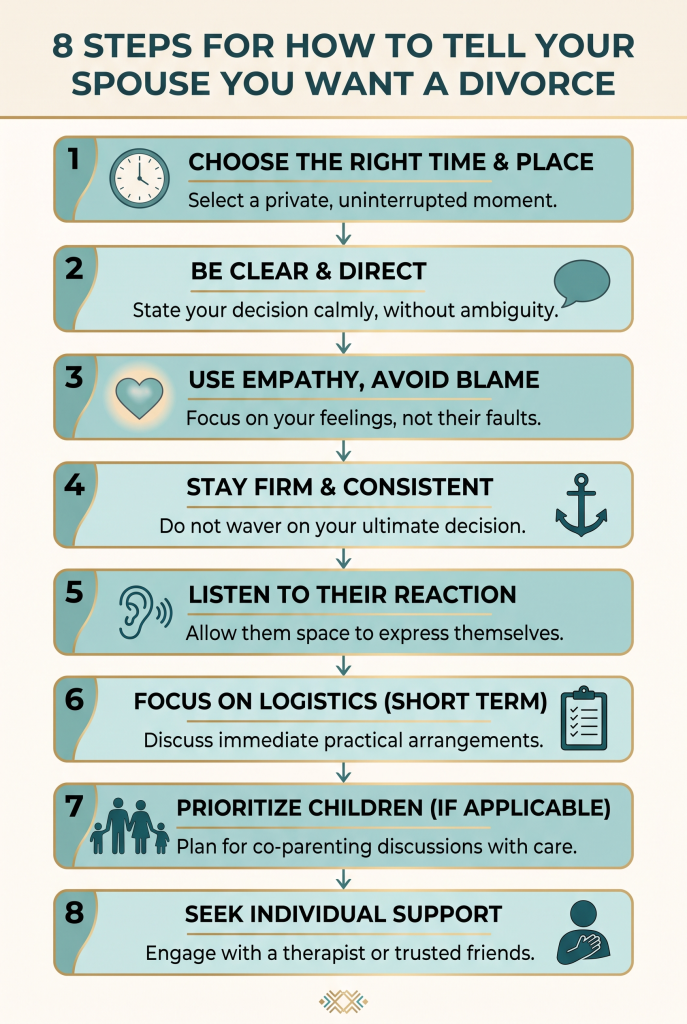
This is the core of what you came here for. These eight steps will walk you through how to tell your spouse you want a divorce in a way that is honest, compassionate, and as constructive as possible given the circumstances.
Step 1 — Choose the Right Time and Place
Timing is not just a courtesy. It is a neurological reality.
When a person is already stressed, fatigued, or emotionally activated, their brain’s ability to receive and process difficult information is genuinely compromised. The amygdala — the brain’s threat-detection center — becomes more active, and the prefrontal cortex, which manages rational thought and emotional regulation, becomes less effective. In plain terms: a stressed brain is a reactive brain, not a receptive one.
This means that choosing the right moment is not just about politeness. It is about giving your spouse the best possible conditions to hear what you are saying without immediately going into crisis mode.
Situations and times to absolutely avoid:
- During or immediately after an argument, when emotions are already running high
- On meaningful dates: birthdays, anniversaries, major holidays, Valentine’s Day, or New Year’s Eve
- When children are home, nearby, or about to return
- Right before or after major life transitions: a new job, a health scare, a family bereavement, a recent loss
- When either of you is physically exhausted, ill, or recovering from something difficult
What right timing actually looks like:
It is a calm afternoon or evening. The children are with a grandparent or at a friend’s house. Neither of you has a major obligation in the next several hours. You are both physically rested and emotionally baseline, not in crisis mode, not celebrating something, not grieving something fresh.
There will never be a perfect moment. But there are clearly better and worse moments, and choosing a better one is entirely within your control.
Step 2 — Start With Empathy and Genuine Appreciation
Before you deliver the news, take a moment to acknowledge the person sitting across from you. This is someone with whom you have shared a life. Regardless of what has gone wrong between you, that life together is real and it deserves acknowledgment.
Leading with empathy is not weakness. It is strategy. It is also simply the right thing to do.
Beginning the conversation with genuine appreciation sets a tone of respect and signals that you intend to handle this with care. It reduces the immediate defensiveness your spouse might feel and creates a slightly less adversarial emotional container for the conversation that follows.
Example phrases that open with grace:
- “I want to start by saying how much I value the life we have built together and everything we have shared.”
- “I am grateful for the years we have had together and for everything you have contributed to our family.”
- “Before I say what I need to say, I want you to know how much I respect you as a person and as a parent.”
One important nuance: be careful not to make your opening so warm and affirming that your spouse genuinely cannot tell that difficult news is coming. Empathy should soften the delivery, not obscure it. Move from appreciation to your core statement relatively quickly and clearly.
If you are co-parenting, this moment also matters for the long game. How you speak to your spouse today will echo in how you work together as co-parents for years to come. The grace you extend now is an investment in that future relationship.
Step 3 — Say It Clearly, Kindly, and Without Ambiguity
Once you have opened with empathy, it is time to say what you came to say. And you need to say it plainly.
Vague language is not kindness. It is confusion. When people dance around the word “divorce” — saying things like “I think I need some space” or “I am not sure this marriage is working anymore” — they leave their spouse with a very different understanding of what is happening than the reality. That gap in understanding causes tremendous harm, both immediately and in the weeks that follow.
Clarity is an act of compassion. Your spouse deserves to understand exactly what you are telling them, even if that understanding is painful.
Scripts that are direct without being cruel:
- “I have been unhappy in our marriage for a long time. I have done a great deal of thinking and soul-searching, and I have come to the decision that I want a divorce.”
- “This is not what I imagined for us, and I am genuinely sorry for the pain this will cause. But I know in my heart that this is the right next step for both of us.”
- “I care about you deeply, and because I do, I want to be honest with you. I have decided that I want to end our marriage.”
If you become overwhelmed and start crying mid-conversation, that is completely human. It does not mean you are changing your mind. You can say exactly that: “I am emotional right now, but that does not change what I am telling you. This is still my decision.”
Tears are not a contradiction of resolve. They are simply evidence that you are a person who loved someone and is grieving the loss of that relationship even while choosing to end it.
Step 4 — Use “I” Language and Eliminate Blame
This step is where many of these conversations go wrong, and it is entirely preventable.
When you blame your spouse for the failure of the marriage — even if their actions genuinely contributed to it — you immediately invite argument. They will defend themselves. You will respond. They will counter. Within minutes, you are no longer having the conversation you came to have. You are having the same argument you have had a hundred times before, just with higher stakes.
Blame-based statements hand your spouse a reason to fight. “I” statements hand them only your experience — which they cannot factually dispute.
The difference in practice:
| Blame Statement | “I” Statement |
|---|---|
| “You never made me feel loved.” | “I have felt unloved in this marriage for a long time.” |
| “You are the reason this marriage failed.” | “I have reached a point where I can no longer be happy in this marriage.” |
| “You never listened to me.” | “I have felt unheard for most of our marriage.” |
| “You made me feel completely alone.” | “I have experienced a deep loneliness that I haven’t been able to overcome.” |
Notice how the “I” statements communicate the same emotional truth without creating a target. Your spouse cannot argue with how you felt. They can only receive it.
Before your conversation, take every statement you plan to make and run it through this filter: Is this about what they did, or about what I experienced? If it is the former, rewrite it. This one discipline will do more to keep the conversation productive than almost anything else.
Step 5 — Anticipate and Prepare for Their Emotional Reaction
Your spouse is about to receive some of the most devastating news of their life. Whatever they feel in response to that news is valid, even if it is incredibly difficult for you to sit with.
Psychologists often reference the five stages of grief — denial, anger, bargaining, depression, and acceptance — as a framework for how people process loss. In this conversation, it is entirely possible that your spouse will move through several of these stages within the space of an hour. It can feel whiplash-inducing to navigate, but it is completely normal.
Here is how to handle the most common emotional responses:
Shock and disbelief: Your spouse may simply go quiet, stare, or say “I don’t believe you” or “This can’t be happening.” Give them a moment. Resist the urge to fill the silence. Then gently restate: “I know this is a shock. I am serious about what I am telling you.”
Anger and rage: Your spouse may raise their voice, say hurtful things, or become accusatory. Do not match their energy. Do not respond to insults with insults. You can say: “I can see you are angry, and that makes complete sense. I am going to give you a moment,” and physically step back if needed. If anger escalates to anything threatening, enact your safety plan.
Bargaining: This is one of the most challenging responses to navigate. Your spouse may suddenly promise to change everything: attend therapy twice a week, stop drinking, become a different person entirely. This is not manipulation — it is grief speaking. It is a desperate attempt to stop the loss from happening. You can respond with compassion and firmness: “I hear you, and I believe you mean that. My decision is still final.” Do not leave any door open that you do not intend to hold open.
Sadness and crying: Allow them to feel it. You do not need to fix it or talk them out of it. Sitting with someone’s pain without running from it or trying to resolve it is one of the kindest things you can do in this moment. What you should not do is offer physical comfort — holding them, hugging them — in a way that sends a confusing message about your intentions.
Denial: Some spouses will simply refuse to accept what they are hearing. They may insist you are confused, going through a phase, or will change your mind. Calmly and clearly restate your decision: “I understand this is hard to hear. I want to be clear that this is not something I am confused about. This is my decision.”
Writing out your spouse’s most likely specific responses — you know them better than anyone — and scripting your replies in advance will help you stay grounded when the conversation becomes emotionally intense.
Step 6 — Stay Firm Without Being Aggressive
There is a meaningful difference between assertiveness and aggression, and understanding that difference is essential here.
Assertiveness means stating your position clearly and holding it calmly. Aggression means using your position as a weapon. The first protects both of you. The second causes unnecessary damage.
When your spouse pushes back — and they almost certainly will — your goal is not to defeat them in an argument. It is simply to remain clear about what you have decided.
If your spouse says, “You cannot just make this decision for both of us” — and this is a very common response — you do not need to argue your right to do so. You can simply acknowledge their feeling and restate your position:
“I understand why this feels unfair. I am not trying to hurt you. But this is the decision I have made, and it is final.”
This technique is sometimes called the Broken Record approach in communication practice. It follows a simple and powerful rhythm: empathy, then restatement. Empathy, then restatement.
“I understand you are hurt. This is still my decision.”
“I know this is not what you wanted. My decision has not changed.”
“I hear how angry you are. I am not going to argue, but I am also not going to change my answer.”
You do not need to win. You do not need to convince your spouse that you are right. You simply need to be clear and consistent. Over and over again, if necessary.
Step 7 — Keep Legal and Financial Discussions Completely Off the Table
This first conversation has one purpose: to communicate your decision. That is it. The moment you introduce legal details, financial arrangements, or custody plans into this conversation, you have overwhelmed your spouse with information they are not emotionally equipped to process right now.
Think about it this way. Your spouse has just had their world upended. Their nervous system is in shock. They may be crying, or numb, or barely holding themselves together. In that state, they cannot make sound decisions about the house, the bank accounts, or the children’s living arrangements. And neither, frankly, can you.
Topics to avoid in this first conversation:
- Who gets the house or what happens to shared property
- Child custody schedules, decision-making rights, or living arrangements
- How financial support will be handled
- The legal process, timelines, or attorney involvement
- Any specific demands or terms
If your spouse pushes you for immediate answers — “Well, are you taking the kids? Are you keeping the house?” — you can redirect gently but firmly: “There are a lot of details that we will need to work through, and I want to do that thoughtfully and fairly. This conversation is not the right moment for that. We will have time to figure all of it out.”
You can, however, introduce the concept of a collaborative process — mediation, for example — as a future path. Something like: “When we are both ready, I would like to explore working through this process with a mediator so that we can both feel that the outcome is fair.” That seeds an important idea without forcing a decision in a moment when no good decision can be made.
Step 8 — Give Your Spouse Time and Space to Process
When the immediate conversation ends, one of the most compassionate and strategically sound things you can do is simply give your spouse time.
Remember the psychological gap at work here. You have been sitting with this decision — building toward it, grieving it, preparing for it — for months, possibly years. Your spouse may have had sixty minutes. The disparity in processing time between the two of you is enormous, and it is entirely unrealistic to expect your spouse to be ready to act, negotiate, or cooperate while they are still in the acute phase of shock.
Practically speaking, giving space looks like this:
- Not immediately contacting an attorney and serving papers the following morning
- Not pushing your spouse to move out or make housing decisions within the first few days
- Not telling the children, extended family, or mutual friends without first allowing your spouse some time to absorb the news
- Not demanding that your spouse respond to logistical questions before they have had space to process
What you should do in this period is take care of yourself. Schedule time with your therapist or counselor. Lean on a trusted friend or family member who can support you without taking sides publicly. Maintain basic physical self-care — sleep, food, movement — even when it feels difficult.
You may feel relief. You may feel grief. You may feel guilt, fear, and a strange sense of quiet clarity all at once. All of it is valid. You have just done one of the hardest things a person can do. You deserve support in the aftermath.
How to Tell Your Spouse You Want a Divorce in Difficult Situations
Not every divorce conversation follows the same script. Certain circumstances require additional preparation, different approaches, or entirely different frameworks.

How to Tell Your Spouse You Want a Divorce When They Are Completely Blindsided
Even when a marriage has been visibly struggling, there are spouses who will be genuinely shocked by the announcement of divorce. This can happen when one partner has minimized the problems, convinced themselves that things were improving, or simply lacks the emotional self-awareness to recognize how serious the situation had become.
If you know your spouse is likely to be completely blindsided, allow extra time and emotional space in your planning. Be particularly careful with your opening — the shock response can be intense and disorienting, and your spouse may need several minutes just to absorb that this conversation is actually happening.
Manage your own guilt carefully. Guilt is a natural response when you are delivering painful news, but it can easily morph into backtracking if you are not careful. Feeling guilty does not mean you are making the wrong decision. It means you are a compassionate person.
After the initial conversation, give a blindsided spouse extra time before any follow-up discussions. They will need to process not just the fact of the divorce but also the realization that their perception of the marriage was so different from yours.
How to Have This Conversation When Children Are Involved
If you have children, there are additional layers of responsibility that shape how you handle this conversation and everything that follows.
The most important rule is non-negotiable: children should have absolutely no part in the initial conversation. They should not be home, within earshot, or in any position to overhear, witness, or sense that something significant is happening. Children are extraordinarily perceptive, and even partial exposure to this conversation can cause anxiety and confusion before they have any context or reassurance.

After the initial conversation with your spouse, and after both of you have had some time to process, plan to tell your children together, as a unified team. Research on children and divorce consistently shows that children fare significantly better when their parents maintain a cooperative, child-centered approach throughout the process. Children are not damaged by divorce itself as much as they are damaged by sustained, unresolved conflict between their parents.
When you tell your children, the most important message you can communicate is twofold: this is not their fault, and both parents love them completely. Beyond that, how much detail you share should be calibrated to your children’s ages and developmental stages.
In your initial conversation with your spouse, you can plant the seed of this cooperative approach: “Whatever happens between us, I am committed to putting the children first and working with you to make sure they feel loved and secure through this.”
How to Tell Your Spouse You Want a Divorce When the Relationship Has Been Abusive
If your relationship has included any form of abuse — physical, emotional, psychological, financial, or sexual — the standard guidance in this article does not fully apply to your situation, and it is important to acknowledge that directly.
In an abusive relationship, your safety supersedes all conventional communication advice. The standard recommendation to have this conversation in person, in a private setting, assumes a baseline level of physical safety that may not exist for you.
Before doing anything else, consult with a domestic violence advocate or family law attorney who understands the specific dynamics of abusive relationships. They can help you create a safety plan tailored to your situation. Depending on your circumstances, it may be advisable to have this conversation with a third party present, in a public location, or in some cases, through legal channels rather than a direct personal conversation.
The National Domestic Violence Hotline (1-800-799-7233) offers confidential support and guidance 24 hours a day. If you are not sure whether your relationship qualifies as abusive, they can help you assess that as well.
Your safety is not negotiable. No advice about being empathetic or compassionate applies in a context where your physical wellbeing is at risk.
How to Have This Conversation When Your Spouse Has Mental Health Challenges
If your spouse lives with depression, anxiety disorders, bipolar disorder, or other significant mental health conditions, their response to this news may be more complex or more intense than average. This does not mean you cannot or should not proceed — your needs and your decision are valid regardless of your spouse’s mental health status. But it does mean additional care and planning are warranted.
Consider whether to involve a therapist in the conversation itself. Some couples find it helpful to have this disclosure take place in a therapeutic setting where a trained professional can help manage the emotional response and ensure your spouse has immediate support.
Use particularly careful, non-inflammatory language. The principles of trauma-informed communication — being calm, clear, non-threatening, and non-blaming — are especially important here.
If your spouse has expressed any thoughts of self-harm in the past, have a plan for connecting them with mental health support immediately after the conversation. This may mean having their therapist’s number ready, knowing the location of the nearest crisis center, or having a trusted family member available to be with them afterward.
What to Avoid When Telling Your Spouse You Want a Divorce
Understanding what not to do is just as important as knowing what to do. These are the mistakes that most commonly turn a painful but manageable conversation into a genuinely destructive one.
Mistakes That Turn a Difficult Conversation Into a Destructive One
Announcing during an argument. When you are both emotionally activated and your nervous systems are in fight mode, no productive communication is possible. The declaration lands as an attack rather than a decision, and the conversation immediately becomes a battle.
Using divorce as a repeated threat. If you have threatened divorce multiple times during arguments without following through, you have trained your spouse to hear the word as hyperbole. When you finally mean it, they may not believe you. Worse, the cycle of threatening and retreating erodes trust and causes its own form of harm.
Telling your spouse via text, email, or letter. With the rare exception of genuine safety concerns that make in-person contact dangerous, this conversation must happen face to face. Text and email strip away tone, nuance, and human presence. They leave your spouse alone with the news, unable to ask questions or express what they are feeling in real time. It is emotionally insufficient and can also have legal implications in some jurisdictions.
Involving children, family, or friends before the conversation. Once you tell someone other than your own therapist or attorney that you are planning to divorce, information spreads in ways you cannot control. Your spouse deserves to hear this from you directly, not secondhand.
Immediately launching into legal logistics. As covered in Step 7, mixing the emotional announcement with legal demands overwhelms your spouse and forces decisions that neither of you is in a state to make well.
Engaging in point-by-point blame arguments. If you spend this conversation relitigating every grievance from the past decade, you leave with nothing resolved and a significant amount of additional damage done.
Offering physical comfort that sends mixed signals. Holding your spouse while telling them you want a divorce creates a genuinely confusing message. Your body is communicating intimacy while your words are communicating ending. This kind of mixed signal can create false hope and make the aftermath more difficult.
Backtracking under pressure. If your spouse pushes hard enough, it can feel easier in the moment to soften your position or suggest that maybe you are not sure. Resist this with everything you have. Backtracking does not spare your spouse pain — it delays and compounds it while also leaving you in a marriage you have decided to leave.
Comparison of Approaches: How to Tell Your Spouse You Want a Divorce
Table 1: Right Approach vs. Wrong Approach
| Factor | Recommended Approach | What to Avoid |
|---|---|---|
| Timing | Calm, private, child-free moment | During arguments, holidays, high-stress days |
| Language | “I” statements, empathy-focused | Blame, accusations, “you always/never” |
| Setting | Private home or neutral location | Public confrontation or via text/email |
| Tone | Firm, compassionate, calm | Aggressive, passive-aggressive, or pleading |
| Topics Covered | Decision announcement only | Legal details, custody, finances |
| Response to Pushback | Acknowledge and restate calmly | Argue, defend, or backtrack |
| Legal Steps | After emotional dust settles | Immediately after the conversation |
| Children | Not present, told together later | Involved or nearby during conversation |
Table 2: Conversation Approach by Relationship Type
| Relationship Dynamic | Best Approach | Key Consideration |
|---|---|---|
| Amicable marriage | Private home conversation | Keep tone collaborative and forward-focused |
| High-conflict marriage | Neutral public location | Have support person available nearby |
| Abusive relationship | With attorney or advocate guidance | Safety plan is non-negotiable; may not be in person |
| Spouse with mental health challenges | With therapist present if possible | Trauma-informed, non-threatening language |
| Long-distance marriage | Video call, not phone or text | Visual cues are essential for this conversation |
| Marriage with children | Child-free setting, plan joint announcement | Co-parenting framework established from the start |
Table 3: What to Say vs. What Not to Say
| Situation | Say This | Avoid This |
|---|---|---|
| Opening the conversation | “I need to talk to you about something important that I have been thinking about for a long time.” | “We need to talk.” with no further context or plan |
| Stating your decision | “I have decided that I want a divorce.” | “Maybe we should think about whether this marriage is working…” |
| Responding to anger | “I understand you are upset, and that reaction makes complete sense.” | “Calm down, you are overreacting.” |
| Responding to bargaining | “I hear you, and I want you to know that my decision is still final.” | “Well, maybe if you went to therapy we could try again…” |
| Closing the conversation | “We both need time to process this before we talk about next steps.” | “So what are we going to do about the house?” |
| On the children | “We will figure out how to talk to the kids together when the time is right.” | “I already told the kids.” or “You can tell them.” |
What to Expect After You Tell Your Spouse You Want a Divorce
Immediate Aftermath — The First 24 to 72 Hours
The hours immediately following this conversation are among the most emotionally volatile of the entire divorce process. Both of you will be flooded. Both of you will be processing something enormous. And neither of you will be at your best.
This is not the time for major decisions. It is the time to create space — physical if needed, emotional always.
If remaining in the same home feels untenable in the immediate aftermath, think through who might leave temporarily, or identify spaces in the home where each of you can have privacy. Avoid sleeping in the same bed if doing so creates confusion or distress for either party.
If your spouse becomes threatening, unstable, or genuinely frightening in the hours after this conversation, take that seriously. Remove yourself and your children from the immediate environment, contact someone you trust, and reach out to an attorney or law enforcement if necessary. Your safety in this period is paramount.
Avoid making any major legal, financial, or parenting decisions in the first 72 hours. Give the acute emotional storm time to pass before taking significant action.
How to Take Care of Yourself After Having This Conversation
People often focus almost entirely on how the spouse receiving the divorce news will feel and forget that the person initiating the conversation is also carrying tremendous weight.
You have just done something that took enormous courage. You have told the truth about something you have been carrying alone for a long time. And in doing so, you have initiated a process that will reshape your entire life. That is not a small thing.
You may feel a complicated mixture of emotions in the aftermath: relief that it is finally said, grief for the marriage and the life you shared, guilt about the pain you have caused, fear about the future, and perhaps a quiet, solid sense of knowing you did the right thing. All of those emotions can coexist. None of them are wrong.

Plan concrete aftercare for yourself:
- Schedule a session with your therapist or counselor as soon as possible after the conversation
- Identify one or two people you trust completely and let them know you may need to reach out
- Do not neglect basic physical needs — sleep, regular meals, movement — even when your emotional state makes that feel unimportant
- Give yourself permission to feel whatever you feel without judgment
You cannot take care of the process ahead — legal, financial, parental — if you do not take care of yourself first.
How to React If Your Spouse Asks for a Divorce Instead
Sometimes, you may sit down to have this conversation and discover that your spouse has something to tell you first. Or you may be reading this guide from the other side — as the person who just received the news rather than the one who delivered it.
If your spouse tells you they want a divorce, your first and most important goal in that moment is to avoid doing the things that feel most instinctive.
Immediate response scripts that protect your dignity:
- “I am in shock right now and I am not able to respond well. I need a few hours before we talk further.”
- “This is incredibly hard to hear. I want to listen to what you are saying, but I need a moment.”
- “I do not agree with this decision, but I want to handle this with respect for both of us.”
What to avoid in your immediate reaction:
Do not lash out, threaten, or bring up everything that has ever gone wrong. Do not beg or plead in a way that compromises your dignity. Do not immediately call friends and family or post on social media. Do not make financial moves out of panic or anger.
Give yourself permission to be devastated. Ask for the time you need to process before any further conversations happen. Then, when you are calmer, assess honestly: do you want to explore saving the marriage, or do you need to begin understanding the divorce process? Both are valid paths. Neither decision needs to be made in the first hour.
When to Get Professional Help Before or During This Conversation
The Role of a Therapist or Divorce Coach
Individual therapy is one of the most valuable resources available to you in the period before, during, and after this conversation.
A therapist can help you:
- Clarify your decision and ensure you are acting from a grounded place rather than a reactive one
- Process the guilt, grief, and fear that accompany this choice
- Rehearse the conversation in a safe environment with someone who can offer feedback
- Manage your emotional state during and after the disclosure
A divorce coach specializes specifically in the logistical and emotional aspects of divorce preparation. If you feel clear on your decision but need help scripting and strategizing the conversation itself, a divorce coach can be an excellent resource.
In some cases, having the conversation in a therapist’s office — with a neutral professional present who can help manage the emotional temperature — is genuinely the best option, particularly when your spouse has a history of volatile reactions.
Ongoing therapy throughout the divorce process is not a luxury. It is one of the most practical investments you can make in your own stability and in your ability to make sound decisions during a profoundly difficult time.
The Role of a Mediator
Mediation is a process in which a trained, neutral third party helps divorcing couples reach agreements on the major issues in their divorce — property division, child custody, financial arrangements — without going to court.
You do not need to bring up mediation in the initial conversation. But introducing it shortly afterward, once some emotional space has been created, can be a powerful way to signal your intention to handle the process cooperatively.
Mediation is significantly less expensive than litigation. It tends to produce outcomes that both parties feel more ownership over, and it generally results in better long-term co-parenting relationships because the process itself is collaborative rather than adversarial. For couples with children especially, mediation is worth serious consideration.
The Role of a Family Attorney
Consulting a family law attorney before telling your spouse you want a divorce is not an act of aggression. It is an act of preparation and self-protection.
Understanding your legal rights — around property, finances, custody, and the divorce process itself — before you have this conversation allows you to move forward from a position of informed clarity rather than fear and uncertainty.
An attorney can tell you what to expect in your jurisdiction, help you understand your financial picture, and advise you on whether there are any steps you should or should not take before initiating the conversation. This knowledge does not commit you to an adversarial process. It simply ensures that you are not navigating one of the most legally significant transitions of your life without understanding the terrain.
Frequently Asked Questions About How to Tell Your Spouse You Want a Divorce
What are the exact words to use when telling your spouse you want a divorce?
There is no single perfect script, but the most effective statements share three qualities: they are clear, they are grounded in “I” language, and they are delivered with empathy rather than blame.
Here are four examples that work well:
- “I have been unhappy in our marriage for a long time. I have thought about this deeply and I have made the decision that I want a divorce.”
- “I care about you and I respect what we have shared together. Because of that, I want to be honest with you: I have decided that I want to end our marriage.”
- “This is not what I imagined for us, and I am truly sorry for the pain this will cause. But I know that this is the right decision for me.”
- “I need you to hear something important. I have decided that I want a divorce, and I want to work through this process with as much respect and care for both of us as possible.”
The essential elements in every version: clarity about the decision, “I” language rather than blame, acknowledgment of shared history, and a signal of how you intend to handle the process.
Should you tell your spouse you want a divorce in person?
Yes, in virtually all circumstances. An in-person conversation allows for human connection, real-time emotional response, and the kind of nuanced communication that text or email fundamentally cannot provide.
Your spouse deserves to receive this news from your face, your voice, and your presence — not from a screen. Text and email strip away everything that makes this communication human. They also leave your spouse completely alone with the news at the exact moment they most need to be able to respond and be heard.
The exceptions are situations involving genuine safety concerns. If meeting in person places you at risk, or if extreme distance makes it genuinely impossible, a video call is a reasonable alternative. A phone call is the next option. Text or email should be used only when every other alternative has been ruled out on legitimate safety grounds.
What if your spouse refuses to accept that you want a divorce?
This is one of the most common challenges in initiating a divorce, and the answer requires both legal clarity and emotional steadiness.
From a legal perspective, in most jurisdictions across the United States and in many countries worldwide, one spouse does not require the other’s consent to file for divorce. It takes two willing people to create a marriage, but only one to end it. Your spouse’s refusal to accept the decision does not prevent the process from moving forward.
From an emotional standpoint, persistent denial is part of grief. It does not mean your spouse has not heard you. It means they have not yet accepted what they have heard. Continue to restate your position calmly and consistently without opening it to debate. Consult your attorney about the next steps when you are ready to proceed legally.
Do not keep re-arguing the decision. State it, hold it, and redirect the conversation toward logistics and process when your spouse is ready.
Should you go to couples therapy before telling your spouse you want a divorce?
The honest answer is: it depends on where you are in the decision-making process.
If you are genuinely uncertain — if there is real question about whether this marriage might be saved with the right support — then couples therapy before the conversation is absolutely worth exploring. A competent couples therapist can help you assess the relationship honestly and give both partners an opportunity to show up differently.
However, if you have reached a point of genuine, clear certainty about your decision, using couples therapy as a preliminary step can be misleading and ultimately unkind. It creates the impression that you are working on the relationship when you have already decided to end it. That false impression makes the eventual disclosure more shocking and painful for your spouse, not less.
If your spouse asks during the divorce conversation whether you would try therapy, you can respond honestly: “I have thought about this for a long time, and I feel certain that I have reached my decision.”
How do you tell your spouse you want a divorce when children are involved?
The first conversation with your spouse should contain no children — literally and figuratively. They should not be home, and child-related logistics should not be the focus of the initial disclosure.
After both of you have had time to process the news, plan to sit down with your children together as a united parenting team. Research from the American Psychological Association and other academic institutions consistently shows that what harms children most in divorce is not the divorce itself — it is prolonged, unresolved parental conflict. Children who go through divorce in homes where parents maintain a cooperative, child-centered approach consistently show better long-term emotional and psychological outcomes.
When telling your children, lead with two messages: this is not their fault, and both parents love them unconditionally. Beyond that, tailor the information to their age and developmental level.
Is it okay to tell your spouse you want a divorce during an argument?
No. It is strongly inadvisable to do so, and here is the neurological reason why.
During a heated argument, both partners are in a state of emotional flooding — a condition in which the physiological stress response has overtaken the brain’s capacity for rational thought and nuanced communication. Research by relationship expert Dr. John Gottman shows that a heart rate above 100 beats per minute during conflict is associated with a measurably reduced ability to process information, listen effectively, or respond thoughtfully.
In this state, your declaration of divorce will not land as a considered decision. It will land as an attack, an escalation, or an ultimatum. Your spouse’s response will be reactive rather than real, and the conversation will almost certainly do more harm than good.
If divorce comes up organically during a heated moment, the best response is to disengage from the current argument and table the larger conversation for a calmer time: “This is too important to discuss right now when we are both this emotional. I need us to come back to this when we have both had time to calm down.”
How long after telling your spouse should you wait before filing for divorce?
There is no universal answer. The right timing depends on your safety, your financial situation, your living arrangements, and the emotional state of both parties.
As a general principle, allowing several weeks for the initial emotional shock to settle before initiating legal proceedings gives both parties a better chance of making sound decisions. Decisions made in the acute phase of emotional crisis — by either party — tend to be reactive, extreme, and often regretted.
That said, there are circumstances where waiting is not advisable or safe. If your safety is at risk, if assets are being hidden or moved, or if your financial security is genuinely threatened, your attorney may advise you to act more quickly.
Consult with a family law attorney about the appropriate timeline for your specific situation.
What should you do if your spouse becomes violent or threatening after you tell them you want a divorce?
Your immediate priority is to remove yourself — and your children — from danger.
Do not attempt to de-escalate a situation that has turned physically threatening. Do not stay to finish the conversation. Get yourself to a safe location as quickly as possible.
Once you are safe, contact law enforcement if violence has occurred or is ongoing. The National Domestic Violence Hotline (1-800-799-7233) is available 24 hours a day and can provide immediate guidance. Contact your family law attorney as soon as possible about emergency protective orders, which can legally prohibit your spouse from approaching you or your children.
It is important to understand that the period immediately following a separation announcement is statistically the highest-risk period in domestically volatile relationships. If there was any prior history of threatening behavior, treat this period with heightened seriousness and have your safety plan activated before the conversation even begins.
How do you tell your spouse you want a divorce if you still love them?
This is one of the most painful versions of this conversation, and it is more common than people often acknowledge.
Love and incompatibility are not mutually exclusive. You can love someone deeply and still know, with equal clarity, that you cannot sustain a healthy, fulfilling marriage with them. You can grieve the loss of the relationship even as you choose to end it. These truths can coexist.
In this situation, be honest about the love without allowing it to obscure the decision. You might say: “I want you to know that this is not about a lack of love. I do love you. But I have come to understand that loving someone and being able to build a healthy life with them are two different things, and I owe both of us the truth about where I stand.”
This kind of honesty, while painful in the moment, is ultimately more respectful than pretending the love does not exist or manufacturing reasons that feel easier to say.
Resources to Help You Through This Process
You do not have to navigate this alone. These resources offer guidance, support, and professional help at every stage of the process.
National Domestic Violence Hotline: 1-800-799-7233 — Available 24 hours a day for anyone in or leaving an abusive relationship.
American Association for Marriage and Family Therapy (AAMFT): www.aamft.org — A therapist finder to help you locate a licensed marriage and family therapist in your area.
Collaborative Divorce: The International Academy of Collaborative Professionals (www.collaborativepractice.com) can help you find collaborative divorce practitioners in your region.
Recommended Reading:
- Conscious Uncoupling by Katherine Woodward Thomas
- Getting the Love You Want by Harville Hendrix — for those exploring whether the marriage can be saved
- Co-Parenting Works! by Tammy Daughtry — for navigating parenting through and after divorce
Online Support Communities: Platforms like Reddit’s r/Divorce and dedicated Facebook groups offer peer support from people who understand exactly what you are going through.
Final Thoughts on How to Tell Your Spouse You Want a Divorce
If you have read this far, you already understand that this is not simply a conversation. It is a defining moment — one that will be remembered by both you and your spouse for the rest of your lives, and one that will shape the quality of every interaction that follows.
The pain of this conversation is real, and it is unavoidable. There is no version of this that does not hurt. But there is a version of it that is done with integrity, with compassion, and with the kind of clear-eyed honesty that respects both the person you are telling and the person you are choosing to become.
Come back to three principles when the moment feels overwhelming:
Clarity over ambiguity. Say what you mean, directly and without leaving room for false hope. Clarity is an act of respect.
Empathy over blame. You can acknowledge your spouse’s pain without accepting responsibility for their choices or negotiating away your own. You can be kind and still be firm.
Firmness over yielding to pressure. You have made this decision from a place of deep knowing. Do not let the discomfort of the moment undo the clarity that took you months or years to find.
This conversation is not the end. It is the beginning of a transition that, when handled with intention, can lead both of you toward lives that fit you better.
Take the time to prepare. Consult a therapist, a divorce coach, and a family law attorney before you sit down with your spouse. Revisit this guide as many times as you need. And when you are ready — and only when you are truly ready — have the conversation with the courage, compassion, and conviction that both you and your spouse deserve.
This article is intended for informational purposes only and does not constitute legal or therapeutic advice. If you are in an unsafe situation, please contact the National Domestic Violence Hotline at 1-800-799-7233 or consult a qualified family law attorney in your jurisdiction.