
Introduction
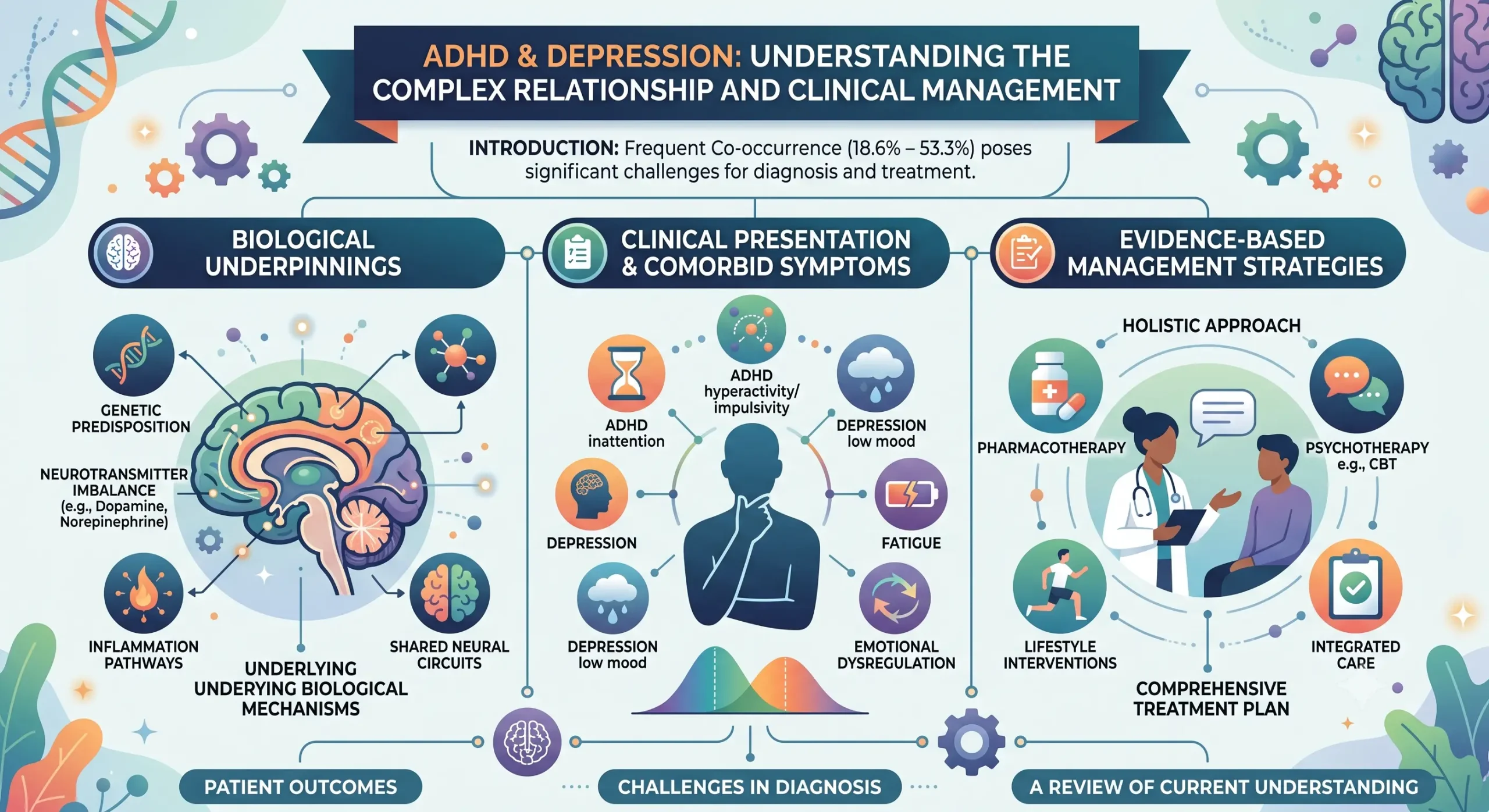
Attention-Deficit/Hyperactivity Disorder (ADHD) and depression represent two of the most common mental health conditions affecting individuals worldwide. Their frequent co-occurrence—with approximately 18.6% to 53.3% of people with ADHD also experiencing depression—presents significant challenges for diagnosis, treatment, and patient outcomes . This comprehensive review examines the biological underpinnings, clinical presentation, and evidence-based management strategies for individuals navigating both conditions.
ADHD is a neurodevelopmental disorder that typically emerges in childhood, with prevalence rates of approximately 5-7% in children and 2-3% in adults . Epidemiological evidence suggests that roughly 50-70% of childhood cases persist into adulthood . Importantly, about 70% of adults with ADHD also experience another mental health condition, with depression and anxiety being the most common comorbidities .
The Neurobiological Connection
Shared Genetic Architecture
The relationship between ADHD and depression extends beyond mere coincidence—it is rooted in shared biology. Twin studies estimate ADHD heritability at approximately 76%, while depression heritability is estimated at 40-50% . More significantly, research has demonstrated a strong genetic correlation between the conditions, with bivariate structural equation modeling revealing that genetic factors contributing to ADHD significantly influence depressive traits .
Mendelian randomization studies have shown that individuals with a genetic predisposition to ADHD face a 21% increased risk of developing Major Depressive Disorder (MDD) . This genetic vulnerability involves specific genes and pathways, including dopamine-related genes (such as DRD4 and DAT1) and serotonin-regulating genes (such as 5-HTTLPR), which play crucial roles in behavior, attention, and mood regulation .
Neurotransmitter Systems
Both ADHD and depression involve dysregulation of key neurotransmitter systems, particularly dopamine and norepinephrine . Dopamine, often termed the “feel-good” neurotransmitter, plays a critical role in motivation, reward processing, and focus. In ADHD, dopamine dysfunction in prefrontal cortex regions contributes to inattention and impulsivity, while in depression, low dopamine levels are linked to anhedonia—the diminished capacity to experience pleasure .
Norepinephrine is equally important, regulating alertness, arousal, and the body’s stress response. Dysfunction in norepinephrine systems contributes to attention problems in ADHD and symptoms like fatigue and poor concentration in depression . When both conditions co-occur, these neurotransmitter imbalances can create a vicious cycle of low motivation, emotional instability, and difficulty finding joy in daily activities.
Brain Circuit Dysfunction
Neuroimaging studies have revealed significant structural and functional abnormalities in individuals with comorbid ADHD and depression. The prefrontal cortex—responsible for attention, impulse control, and executive function—and the amygdala—which regulates emotional responses—both show reduced activity in individuals with comorbid conditions .
Event-related potential (ERP) studies examining attention and behavioral inhibition have demonstrated that individuals with comorbid ADHD and MDD exhibit weakened neural responses during inhibitory control tasks compared to healthy controls . Specifically, researchers have observed reduced P3 amplitude—a neural marker of attention allocation—and significantly longer Nogo N2 latency, which reflects the time needed to detect the need for inhibition (400 ms in the comorbid group compared to 350 ms in controls) .
Additionally, the limbic-cortical-striatal-pallidal-thalamic (LCST) circuit, which regulates emotion and reward processing, shows disruption in both conditions. This dysfunction makes it harder to experience pleasure or satisfaction—a hallmark feature of depression that overlaps with motivational deficits in ADHD .
Clinical Presentation and Diagnostic Challenges
Overlapping Symptoms
The clinical overlap between ADHD and depression creates significant diagnostic challenges. Both conditions commonly present with:
Difficulty concentrating
Fatigue or reduced energy
Sleep disturbances
Reduced motivation
Impaired decision-making
This symptom overlap can lead to misdiagnosis or missed diagnosis. For instance, inattention may arise secondary to depression, and depressive symptoms may be mistakenly attributed solely to the functional impairments of untreated ADHD . A systematic review in Frontiers in Psychiatry notes that stress, depression, and anxiety may result from undiagnosed and untreated ADHD, further complicating the clinical picture .
Distinguishing Features
Despite overlapping symptoms, important distinctions exist:
ADHD-related symptoms tend to be:
Chronic, with onset in childhood (typically before age 12)
Present across multiple settings (school, work, home)
Associated with hyperactivity or impulsivity (in some subtypes)
Reactive to environmental demands and structure
Depressive symptoms are characterized by:
Persistent sadness, hopelessness, or irritability
Loss of interest or pleasure in activities (anhedonia)
More generalized feelings of worthlessness or guilt
Psychomotor retardation or agitation
Significant changes in appetite or weight
The Royal College of Psychiatrists explains that ADHD-related mood swings are typically reactive and short-lived, while depression involves a persistent low mood and loss of interest lasting for weeks or longer .
Gender Differences
Gender plays a significant role in comorbidity patterns. Research involving 40,103 adults with ADHD found that anxiety, depression, bipolar disorder, and personality disorders are more common in females, while schizophrenia and substance use disorders are more prevalent in males . Female patients with ADHD often present with more inattentive and internalizing symptoms, which may allow them to develop coping strategies that mask core symptoms, potentially delaying diagnosis and treatment .
The Bidirectional Relationship
The relationship between ADHD and depression is bidirectional and self-perpetuating. The chronic challenges of managing ADHD symptoms—including difficulties at work, academic underachievement, and relationship problems—can lead to feelings of sadness, disappointment, and ultimately clinical depression . Conversely, depressive symptoms can worsen ADHD-related difficulties, creating a vicious cycle.
Comorbid anxiety may also significantly alter the manifestation of ADHD symptoms. For individuals with ADHD and co-occurring anxiety disorders, working memory deficiencies may be a significant area of impairment, with these three symptoms—working memory problems, attention difficulties, and anxiety—intricately intertwined . This bidirectional relationship explains why individuals with comorbid conditions experience greater disease burden, longer illness duration, and reduced quality of life compared to those with either condition alone .
Interpersonal Factors
Research has identified significant interpersonal contributors to the development of depression in individuals with ADHD. Children with ADHD face elevated risks of peer rejection and social isolation due to impulsivity and social skill difficulties, which undermine self-esteem and social identity, facilitating the pathway from childhood ADHD to adolescent depression .
Parent-child relationships also play a crucial role. Inconsistent parenting, high parental criticism, and low emotional warmth have been associated with emotional instability and low self-esteem in children with ADHD, increasing the likelihood of developing depression later in life . Notably, children with comorbid ADHD and MDD were more likely to have mothers with a history of depression, suggesting both genetic and environmental contributions .
Evidence-Based Treatment Approaches
Pharmacological Interventions
Treatment of comorbid ADHD and depression requires careful consideration of both conditions. The Canadian Network for Mood and Anxiety Treatments (CANMAT) provides specific recommendations for management :
For MDD with comorbid ADHD:
When depression is moderate to severe, treating MDD should be the priority.
In mildly depressed or euthymic patients, the order may be reversed.
First-line treatments include bupropion, an antidepressant combined with a long-acting stimulant, or an antidepressant plus CBT.
Second-line options include desipramine, nortriptyline, and venlafaxine.
For Bipolar Disorder with comorbid ADHD:
Mood-stabilizing medications should be prescribed before initiating ADHD therapies.
Bupropion is considered a reasonable first-line treatment.
Mixed amphetamine salts and methylphenidate may be considered for patients determined to be at low risk for manic switch.
For mild cases:
Non-stimulant medications like atomoxetine or guanfacine may be better tolerated.
Psychotherapeutic Approaches
Cognitive-Behavioral Therapy (CBT) has demonstrated significant benefits for individuals with comorbid ADHD and depression by improving coping skills and emotional regulation . Other effective therapeutic approaches include Interpersonal Psychotherapy (IPT), behavioral activation, and mindfulness-based therapies .
For children and adolescents, psychosocial training and social skills development can reduce the likelihood of developing MDD later in life by addressing peer difficulties and building self-esteem .
Clinical Guidelines and Screening
The NICE ADHD guideline (NG87) recommends that anyone with ADHD showing persistent low mood or irritability should be screened for depression . Additionally, the NHS advises seeking help when ADHD-related mood issues affect energy, sleep, or daily functioning.
A consensus-derived diagnostic algorithm developed by a panel of psychiatrist-clinicians recommends a three-step process for diagnosing adult ADHD in patients presenting with depressive symptoms . This emphasizes the importance of direct assessment of children for depressive symptoms, as parents are often poor informants of depression, and the use of self-report questionnaires as an important adjunct to clinical interview .
Conclusion
The connection between ADHD and depression runs deep—touching everything from genes to brain chemistry to interpersonal relationships. Understanding this complex relationship is crucial for clinicians, patients, and families alike. Advances in neuroimaging, genetics, and clinical research have illuminated the shared biological underpinnings and bidirectional nature of these conditions .
For patients navigating both conditions, integrated treatment approaches that address both ADHD symptoms and depressive symptoms offer the best outcomes . Clinicians should remain vigilant in screening for comorbid depression in ADHD patients and for ADHD in patients presenting with mood symptoms. Early intervention, appropriate pharmacological and psychological treatments, and attention to interpersonal factors can significantly improve quality of life for individuals living with both conditions.
As research continues to evolve, further studies are needed to investigate the underlying causes of these comorbid conditions and develop more targeted interventions . For now, the evidence supports a comprehensive, individualized approach that addresses the whole person—not just their diagnoses—in the context of their unique biological and environmental circumstances.
References and Further Reading
Fu, X., Wu, W., Wu, Y., Liu, X., Liang, W., Wu, R., & Li, Y. (2025). Adult ADHD and comorbid anxiety and depressive disorders: A review of etiology and treatment. Frontiers in Psychiatry, *16*, 1597559. Available at: https://www.frontiersin.org/journals/psychiatry/articles/10.3389/fpsyt.2025.1597559
Bui, T. H. (2025). Comorbidity of ADHD and Major Depressive Disorder: Exploring Biological and Interpersonal Factors. Undergraduate Research Journal for the Human Sciences, *18*. Available at: https://newprairiepress.org/cgi/viewcontent.cgi?article=1165&context=urjhs
Bond, D. J., Hadjipavlou, G., Lam, R. W., McIntyre, R. S., Beaulieu, S., Schaffer, A., & Weiss, M. (2012). The Canadian Network for Mood and Anxiety Treatments (CANMAT) task force recommendations for the management of patients with mood disorders and comorbid attention-deficit/hyperactivity disorder. Annals of Clinical Psychiatry, *24*(1), 23-37. Available at: https://pure.johnshopkins.edu/en/publications/the-canadian-network-for-mood-and-anxiety-treatments-canmat-task-
Arnsten, A. F. T., & Rubia, K. (2012). Neurobiological circuits regulating attention, cognitive control, motivation, and emotion: Disruptions in neurodevelopmental psychiatric disorders. Journal of the American Academy of Child and Adolescent Psychiatry, *51*(4), 356-367. Available at: https://www.mendeley.com/catalogue/556df80a-1467-3acc-8731-5c34cb064b30/
NHS and NICE Guidelines for ADHD and Depression. Available at: https://www.nice.org.uk/guidance/ng87
MyPatientAdvice Health Psychology. In ADHD + Depression: How Are Both Neurotransmitters Involved? Available at: https://mypatientadvice.co.uk/knowledge-base/adhd/understanding-adhd/neuroscience-and-biology/dopamine-and-norepinephrine-systems/in-adhd-depression-how-are-both-neurotransmitters-involved/
Disclaimer: This article is for educational purposes only and does not constitute medical advice. Individuals experiencing symptoms of ADHD or depression should consult with a qualified healthcare professional for diagnosis and treatment recommendations.